


By Emily Socolinsky
Coach Emily is the Owner and Head Coach of Fivex3 Training, located in Baltimore, Maryland.
Most people think a hip replacement marks the beginning of the end—that life will become smaller, slower, and more limited—but it doesn’t have to. Whether you’re 60, 70, or 80 years of age, a single factor predicts how well you’ll recover more than almost anything else: how strong you are before surgery. I learned that lesson firsthand.
I was diagnosed at age 41 with arthritis. This was in 2015. At the time, my hip was bad, but it wasn’t that bad. I had been a dancer my whole life and had just retired from dance a year before this diagnosis. It was not surprising. What was surprising was the orthopedist’s statement that I would see him in 10 years for a hip replacement. I shrugged that off and told myself he was wrong.
And yet, he was right. Ten years later, I decided it was time to see an orthopedic hip doctor. Looking back, the warning signs had been there for years. Walking had become harder, and stairs were difficult. I couldn’t stand on 1 leg to put on my pants. Activities I loved became painful. When the orthopedic surgeon showed me my x-rays, the answer was obvious: advanced arthritis. A total hip replacement wasn’t something to fear. It was the solution.
“Osteoarthritis. In both hips,” Dr. Kovaks said to me as we looked at the x-ray. “Bone spurs, almost bone on bone in the right hip. Yep, it’s not good. You can try injections and drugs, but your best bet is a total hip replacement. And at your age, you would do great.”
I immediately thought back to that first doctor, who had been my dad’s surgeon. He had been right. My father had been diagnosed with arthritis in his hips when he was 40 years old, and the doctor told him then that he would need a hip replacement in 10 years. Like father, like daughter. My father was told at 50 that he needed a new hip. He decided to stick with injections and drugs, and did not have his first hip replacement until age 65. I was not going down that road. I made an appointment with the hip surgeon at the end of January and decided to have the hip replacement done. Originally, I made the appointment for the end of May, but I moved that up to early April as the pain started to become too much to bear. I am so glad that I did not wait.
Prior to my surgery, I did not stop moving, and I most certainly did not stop going to the gym. For the past 15 years I’ve been a strength coach and have helped hundreds of people—from teenagers to adults in their 80s—become stronger. Years before my hip replacement, strength training had already changed my life after a serious back injury. By the time arthritis made hip replacement unavoidable, I knew 2 things: movement matters, and strength would be my greatest asset during recovery.
When I learned that the only solution to my hip issue was a hip replacement, I was more than ready, and I never stopped training. I knew that before surgery, movement mattered. I didn’t stop exercising because I had arthritis; instead, I modified what I was doing. For me, that was making changes to the weight on the bar or squatting to a box. The goal wasn’t to exercise through pain. The goal was to stay as strong and active as possible until surgery.
I made a point of training as much as I could leading up to the surgery, as I knew the stronger I was going into the surgery, the better. I spoke to a friend of mine who had just had her second hip replacement. She gave me a lot of information about what to do after the surgery, how to take care of myself, and when I might be able to start training again. I also made an online appointment with my friend, John Petrizzo, DPT, to discuss the hip surgery and what to expect afterwards. We also scheduled a day to talk a week after the surgery to see where I was and discuss how to proceed with my training. While most people preparing for surgery are buying grab bars, raised toilet seats, and sock aids, I was planning my return to the gym. I had my priorities.
I had my surgery on Monday, April 13, 2026. It was a total right hip replacement, anterior approach. There are 3 types of hip replacements: anterior, posterior, and lateral. The most common procedures are the anterior and posterior, and most surgeons perform the anterior approach as there are fewer restrictions on the patient after the surgery. The anterior approach also allows a person who is very active prior to surgery get back to their regular routine faster. There are fewer restrictions for this approach, so for the active individual, the surgeon will typically choose this approach.
My operation took about 2 hours from start to finish (7:30–9:30 am). I came out of anesthesia around 10:30 to 11 am, and the nurses got me up and walking around noon. They watched me take the stairs, get in and out of a “car,” and then sent me home around 1 pm. And that was that. No physical therapy was scheduled. My surgeon did not even come to see me to discuss how the surgery had gone. My husband picked up my medications, and I was wheeled out to the car.
Recovery and rehabilitation
Immediately postoperative (postop). That afternoon, I recuperated on the couch in my living room. I iced my hip and knee every 20 minutes or so and would get up and move around every hour or so. I was weight bearing and had been encouraged to walk as much as I could, as this was the best rehab I could do for my hip. My surgeon had 3 rules for me: “Rule 1: Don’t fall. Rule 2: Don’t fall. Rule 3. Don’t fall.” So I definitely made a point of not falling.
The first week was tiring and I would get exhausted after doing the slightest bit of movement. This was to be expected, as your leg has been really man-handled. My body was trying to recover so when I did too much, the exhaustion would creep in and I would have to lie down and rest. My first week was most definitely the hardest as I had to get used to sleeping on my back, taking my daily medication, and not doing too much. The days after surgery were spent icing my hip and thigh, doing my rehab exercises on the couch, walking around the living area, and taking the stairs a couple times. I did not do any “prehab” prior to the surgery, as my strength-training routine was my prehab. However, I did watch videos that the surgeon sent me demonstrating how to get in and out of a car or in and out of the shower. These were very helpful.
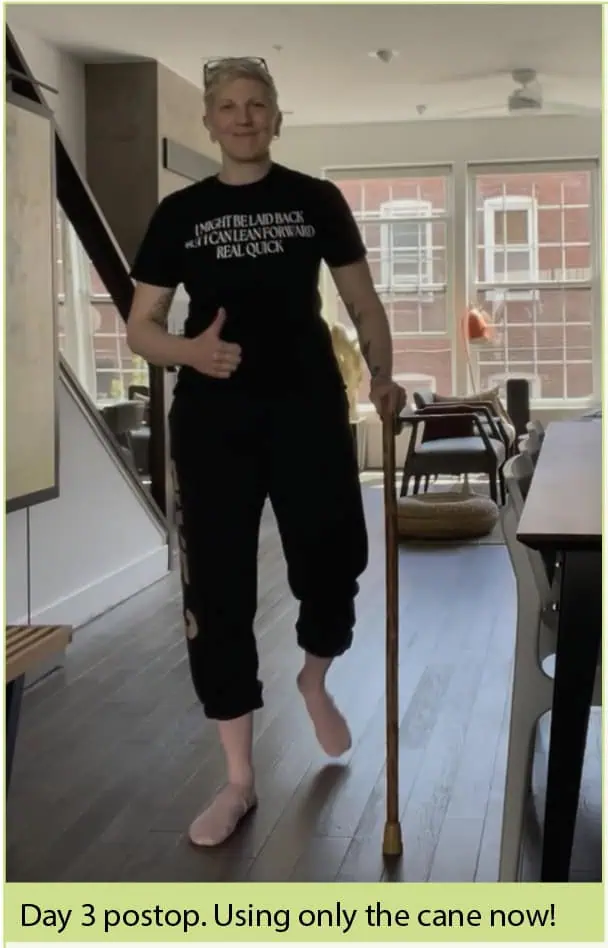
I used my walker on Monday (day of surgery), Tuesday, and Wednesday of that week. By Thursday, I was practicing with the cane and taking the stairs using alternate legs. By Friday, my mother picked me up on her way to my gym and I got to visit with my members. On Sunday, I was at the gym again with my husband, and I began with very light, carefully controlled movements, such as squatting to a box, to rebuild my confidence. I had returned to the gym 6 days after surgery ready to begin my rehab.
I was never afraid that the replacement would fail. I was never worried about walking again. The only thing that surprised me about my surgery was how tired I got doing just the slightest extra movement. I really did need to let my body rest more than I had anticipated. I trusted the process because I trusted the work I’d already put into my body. I knew recovery would require patience, but I never doubted that I’d walk again. Age certainly affects recovery, but it isn’t the only factor. Strength, balance, muscle mass, and overall health matter, too—and those are things we can improve at almost any age.
One week postop. The next day, I went back to work. I was moving well, walking with the cane, and starting my training regimen again, so I figured I could sit at home and ice my hip or sit at the gym and ice my hip. I’d rather be at the gym with my clients, so I went back to work.
My private clients that I have in the mornings on Monday, Wednesday, and Friday picked me up from my house and drove me to the gym in the mornings. I only live 6 blocks away from the gym, but I was not allowed to walk that far just yet, nor was I allowed to drive. For the first 2 weeks after surgery, I had rides to and from the gym, thanks to my members. My coaches helped me out for those 2 weeks as well, and I was able to ease back into coaching part-time, working in just the morning or just the evening. This helped tremendously because I was definitely tired after each coaching session. My first Wednesday morning back, I did WAY too much and paid for it later. I was not in pain, just utterly exhausted, and feeling the way I feel when I’m getting sick. I learned my lesson and acknowledged that I needed to listen to my body and sleep if I needed to.
Two weeks postop. Two and a half weeks after my surgery, I saw the physician assistant. She took off the bandage, talked to me about my recovery, and I asked if I could drive. I was not on any painkillers, so she gave me permission to drive to the gym and back. I was thrilled. After that first week back and forth to the gym, I felt comfortable enough to drive anywhere.
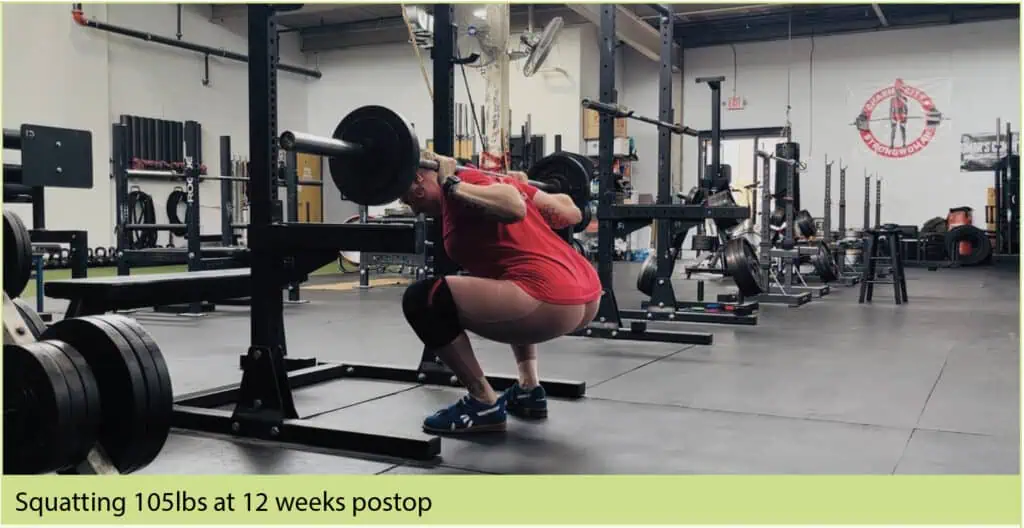
Three weeks postop. Even though I was not prescribed physical therapy, I did make an appointment with a physical therapist who is also an orthopedic specialist (who happened to be a former client), so I knew I was in good hands. I visited him just 1 time, 3 weeks after my surgery. He did an evaluation, gave me permission to start adding weight to my squatting, and told me I was heading in the right direction.
Five weeks postop. Five weeks after my surgery, I was on a plane heading to my nephew’s graduation in Colorado. The drive from Denver to Longmont was about an hour, and I did great on the plane and then in the car. No issues with my legs. No issues with my hip. It was a great weekend.
Six weeks postop. The following week, I met with my surgeon who took one look at me walking, moved my leg around and said “Well, you are good. Get an x-ray in a year.” That was it? Yep, that was it. He wished me good luck and out the door I went. I have not seen him since.
Three months postop. July 13, 2026, was the 3-month mark since my total hip replacement. If you saw me, you would never know that I had ever had this surgery. I am walking normally and training normally.
So, what made my recovery so fast?
Strength.
If you’re reading this because you have been told that you need a hip replacement, don’t spend your energy worrying about the surgery. Spend it preparing for it. Start building strength. Practice getting in and out of chairs. Work on your balance. Keep moving. Every bit of strength you build before surgery becomes an asset afterward. And if you are preparing for your own hip replacement, don’t compare your timeline to mine. Every recovery is different. The important thing is to keep moving within your surgeon’s guidelines and gradually rebuild your confidence. I realize my recovery was faster than many people’s. I was fortunate to go into surgery already very active, and I had years of strength training behind me. My goal isn’t for you to recover on my timeline; it’s to show how much being stronger beforehand can influence the recovery process.
A hip replacement doesn’t have to be the end of an active life. In many cases, it can be the beginning of getting your life back. The biggest reason my recovery went so smoothly wasn’t luck. It wasn’t because I was younger than most hip replacement patients. It wasn’t because I had some secret rehabilitation program. It was because I was strong before I ever walked into the operating room. Most people think about rehabilitation after surgery; I would encourage you to think about prehabilitation instead.
The best time to prepare for surgery isn’t the month before it happens; it’s today. Whether you’re 60, 70, or 80, it’s never too late to become stronger. Building muscle, improving balance, and maintaining mobility can make everyday life easier now—and can make recovering from illness, injury, or surgery far less difficult later. Stronger muscles protect joints. Stronger people recover faster after a surgery or injury. Strength reduces falls. I was not worried at all about falling after my surgery. That thought never even crossed my mind. Strength improves independence, and muscle predicts longevity.
It’s about being able to climb the stairs without holding the railing. It’s about getting up from a chair without using your hands. It’s about carrying groceries, traveling, playing with grandchildren, gardening, or simply walking without pain. As we age, our bodies will face challenges. Arthritis happens. Falls happen. Surgeries happen. We don’t get to choose those things. What we can choose is how prepared we are when those challenges arrive. What we can choose is how strong we are when they happen. The stronger you are, the harder you are to break, the faster you recover, and the sooner you get back to living your life.
Strength isn’t about lifting the heaviest weight in the gym. It’s insurance for the life you haven’t lived yet. Looking back, I realize my recovery didn’t begin on April 13, the day of my surgery. It began years earlier…the day I decided to become stronger.