

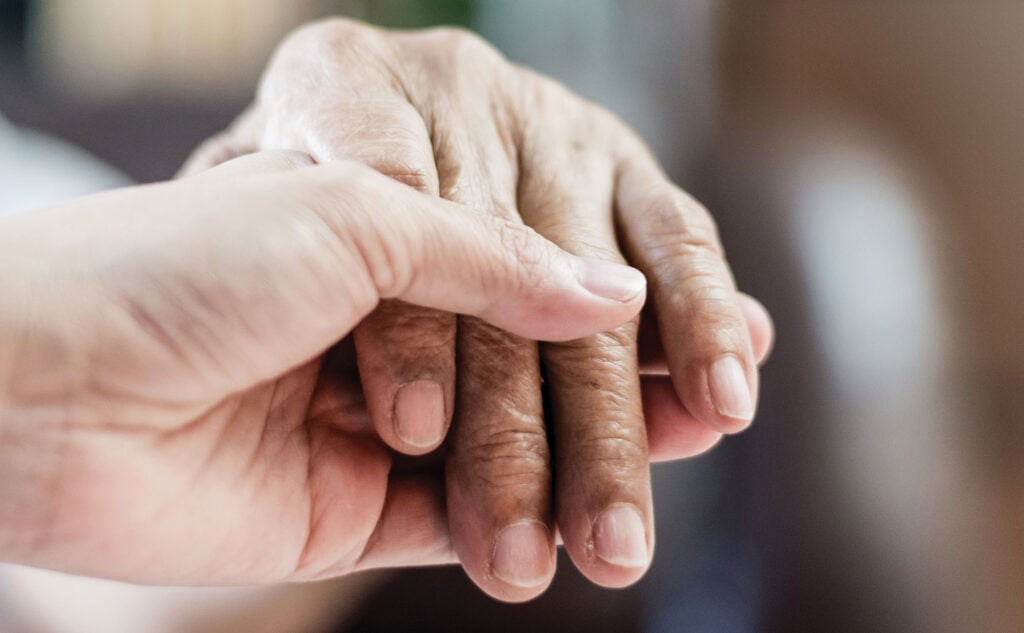
Caregivers, or care partners, provide invaluable support to patients with cancer, sometimes to the detriment of their own health. They can experience a negative impact on quality of life (QoL) and emotional wellbeing due to their new role. It is not uncommon for care partners to experience symptoms of anxiety, depression, or post-traumatic stress disorder.1,2 Care partners might also experience uncertainty, isolation, exhaustion, loss of control, and avoidance or suppression of their own emotions.1,3 The convergence of these symptoms and feelings with the responsibilities of becoming a care partner, such as adapting to the diagnosis, changing routines, organizing care, and monitoring for treatment-related adverse effects, among many others, can all contribute to the emotional burden care partners feel.
How does the care partner role contribute to emotional burden?
In addition to practical responsibilities, care partners often also perform emotional work, defined by Thomas et al as “the emotional effort made by individuals to manage their own feelings and those of others.”4 Care partners of patients with cancer often work to support the patient emotionally in various ways, such as by ensuring the patient does not feel alone, always being available, maintaining a sense of normalcy, expressing hope, and staying positive.1,4,5 Sometimes, care partners feel the need to shield the patient from potentially upsetting information, unwanted visitors, and even the care partner’s own emotions and reactions.1,5,6 Furthermore, care partners might deprioritize their own needs to focus more on the patient; a 2006 study found that about 1 in 5 care partners of patients with cancer did not want to seek professional support to address their own physical symptoms or symptoms of distress.7
In a 2020 study, researchers found that greater burden, psychological morbidity, and unmet emotional needs were associated with decreased QoL in multiple myeloma care partners.8 Higher satisfaction with social support and greater use of effective coping strategies were linked to improved QoL. Emotional unmet needs mediated the effects of psychological morbidity and social support on QoL, which highlights emotional needs as an important target for intervention to improve QoL in care partners.8
Addressing emotional needs
Implementing effective coping strategies can have a positive effect on emotional wellbeing and QoL. One study of care partners of patients with hematologic malignancies undergoing hematopoietic stem cell transplantation found that while 55.9% of respondents were considered high utilizers of acceptance as a coping strategy, less than half were high utilizers of positive reframing (45.9%), emotional support (41.8%), and active coping (27.1%); however, a notable proportion of patients were high utilizers of self-blame (31.8%), denial (29.4%), and behavioral disengagement (12.9%). Overall, high use of approach-oriented coping strategies (acceptance, active coping, positive reframing, and use of emotional support) was reported in 49.4% of participants, and high use of avoidant coping strategies (behavioral disengagement, denial, and self-blame) was reported in 32.9%. The use of approach-oriented coping was associated with fewer symptoms of anxiety and depression and improved QoL, whereas use of avoidant coping strategies was associated with greater symptoms of anxiety and depression and worse QoL.9 These findings highlight the importance of using healthy coping strategies to address emotional burden, since utilizing ineffective coping strategies can contribute to further burden and worse QoL.
A variety of tools and strategies can be used to alleviate emotional burden in care partners. Clear and supportive communication with healthcare teams is important, as they can provide support in various ways, such as:1,3,5
- Provide education on the disease course and treatment regimens;
- Alleviate uncertainty;
- Help adjust to the situation;
- Reduce care partner stress related to treatment-emergent adverse events;
- Promote self-care among care partners and patients; and
- Serve as a point of contact for care partners if they need aid.
- Care partners can practice self-care in the following ways:10,11
Reach out for help. Social support from family and friends is crucial; no one can do it all alone. Others can provide help with tasks such as cooking, running errands, childcare, and cleaning. It is also helpful to have someone with whom you can talk and share your feelings.
Make time for yourself. Caring for someone 24/7 is an impossible task—care partners have to take time to care for themselves, even if it’s only for a few minutes each day. Take a walk, watch TV, call a friend, partake in a hobby—anything that makes you feel good!
Join a support group. Through support groups, care partners can share their experiences, provide support and advice, and feel a sense of community.
Take care of your body. Being a care partner does not mean you should neglect your own health. Keep up with your own healthcare visits, maintain a balanced diet, be physically active, and get enough sleep.
Bottom Line
The cancer journey greatly affects both patients and care partners. The emotional toll of caregiving should not be ignored. Adopting healthy coping strategies and reaching out to others for support is crucial for care partners.
Sources
- Morris M, Marshall-Lucette S. The experience of myeloma caregivers during home-based oral chemotherapy treatment: a qualitative study. Semin Oncol Nurs. 2017;33(3):362–371.
- O’Donnell EK, Shapiro YN, Yee AJ, et al. Quality of life, psychological distress, and prognostic perceptions in caregivers of patients with multiple myeloma. Blood Adv. 2022;6(17):4967–4974.
- Kurtin S, Lilleby K, Spong J. Caregivers of multiple myeloma survivors. Clin J Oncol Nurs. 2013;17 (Suppl):25–32.
- Thomas C, Morris SM, Harman JC. Companions through cancer: the care given by informal carers in cancer contexts. Soc Sci Med. 2002;54(4):529–544.
- Quiñoa-Salanova C, Porta-Sales J, Monforte-Royo C, Edo-Gual M. The experiences and needs of primary family caregivers of patients with multiple myeloma: a qualitative analysis. Palliat Med. 2019;33(5):500–509.
- Stenberg U, Ruland CM, Olsson M, Ekstedt M. To live close to a person with cancer–experiences of family caregivers. Soc Work Health Care. 2012;51(10):909–926.
- Osse BH, Vernooij-Dassen MJ, Schadé E, Grol RP. Problems experienced by the informal caregivers of cancer patients and their needs for support. Cancer Nurs. 2006;29(5):378–388; quiz 389–390.
- Graça Pereira M, Vilaça M, Pinheiro M, et al. Quality of life in caregivers of patients with multiple myeloma. Aging Ment Health. 2020;24(9):1402–1410.
- Amonoo HL, Johnson PC, Nelson AM, et al. Coping in caregivers of patients with hematologic malignancies undergoing hematopoietic stem cell transplantation. Blood Adv. 2023;7(7):1108–1116.
- Support for caregivers: caring for the caregiver. National Cancer Institute. Sep 2024. Accessed 23 Mar 2026. https://www.cancer.gov/publications/patient-education/caring-for-the-caregiver2024.pdf
- Caregiver resource guide: caring for a loved one with cancer. American Cancer Society. 2023. Accessed 23 Mar 2026. https://www.cancer.org/content/dam/cancer-org/cancer-control/en/booklets-flyers/american-cancer-society-caregiver-resource-guide.pdf