
By Aliza Becker, BA, MPS
Ms. Becker is the managing editor of the The Journal of Innovations in Cardiac Rhythm Management, a freelance editor, and an instructor in the George Washington University’s MPS Publishing program.
Sugar is among the oldest sweet foods known to humankind, with a historical timeline that traces its cultivation and production across the world. The most widely accepted theory suggests that sugarcane may have been first domesticated from wild cane (Saccharum robustum) in the New Guinea region approximately 8,000 years ago.1,2 From there, cultivated sugarcane (Saccharum officinarum) was transported by humans into Southeast Asia and beyond, where it encountered and hybridized with related wild Saccharum species, giving rise to new cultivated forms.1,3 Although the indigenous people of New Guinea are thought to have consumed sugarcane itself as a food, subsequent technological developments enabled the production of sugar crystals from cane juice in India during the early Common Era,4 and knowledge of sugar production subsequently spread through Asia and the Middle East before eventually reaching the Mediterranean world.5 During the Middle Ages (approximately 500–1600 CE), sugar became increasingly available in Europe by way of growing trade networks and greater contact between Europe and the eastern Mediterranean (eg, during the Crusades).6 Sugar production continued to expand thereafter, including throughout the Americas, where large-scale sugar production developed in countries such as Brazil.7 Then, during the 19th century, the industry was further transformed by technological advances, including the introduction of steam power in sugar manufacturing8 and the development of methods for producing sugar from sugar beets.9 Continued technological advances in sugar manufacturing during the 19th and 20th centuries further enabled sugar to be produced on an increasingly large and efficient scale.10
Today, sugar has permeated our diets. Although foods contain some naturally occurring sugars (eg, fructose in fruits, lactose in milk and dairy products), added sugars are also widely consumed in the United States (US) diet. According to 2017 to 2018 National Health and Nutrition Examination Survey (NHANES) data, both US adults and children/adolescents aged 2 to 19 years consumed an average of 17 teaspoons (approximately 68 g) of added sugars per day.11 In contrast, the Dietary Guidelines for Americans recommend that individuals aged 2 years and older limit added sugars to less than 10% of total daily energy intake (eg, no more than 200 calories, or 50 g, from added sugars on a 2,000-calorie diet).12 Importantly, higher dietary sugar consumption has been associated with adverse health outcomes, including excess body weight/obesity, type 2 diabetes, cardiovascular disease, and dental caries (eg, cavities).13 These concerns have contributed to growing interest in lower-sugar and sugar-free alternatives.
Available Alternatives to Sugar
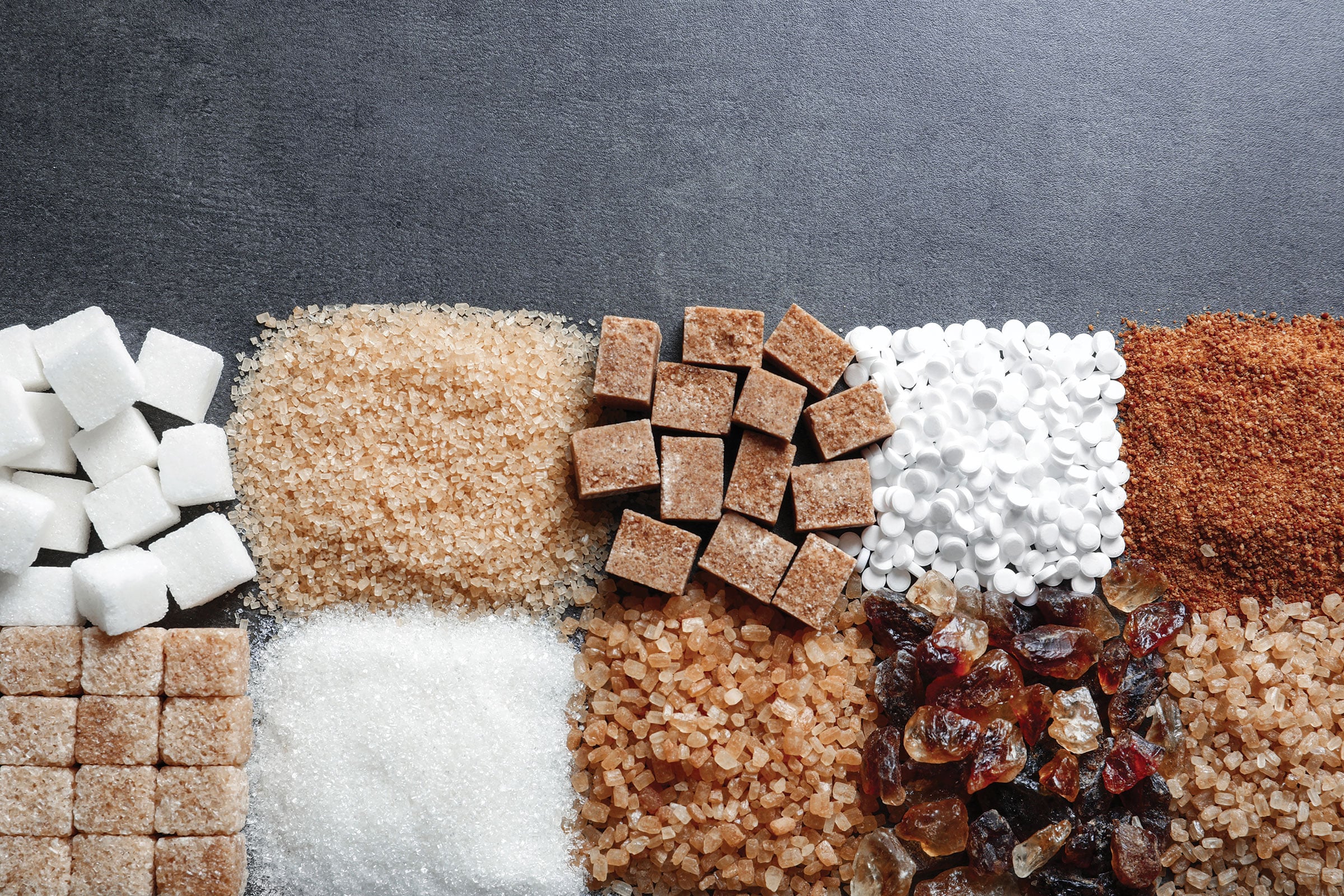
Sugar alternatives can be broadly divided into several categories: artificial sweeteners, natural sweeteners, sugar alcohols, and alternative sugars.
Artificial/synthetic sweeteners. The first widely used artificial sweetener, saccharin, was discovered accidentally in 1879 by Constantin Fahlberg while working in Ira Remsen’s laboratory at Johns Hopkins University.14 Subsequent sweeteners included cyclamate, discovered in 1937; aspartame, discovered in 1965; and acesulfame potassium and sucralose, discovered in 1967 and 1976, respectively.15 To date, the US Food and Drug Administration (FDA) has reviewed 6 artificial sweeteners commonly used in foods: aspartame, acesulfame potassium, sucralose, neotame, advantame, and saccharin.16
Broadly, artificial sweeteners are significantly sweeter than sucrose (ie, common table sugar), ranging from approximately 200-fold sweeter for acesulfame potassium to several thousand-fold sweeter for neotame, allowing them to be used in smaller quantities to achieve a similar level of sweetness without as large a caloric load.16 However, as their use expanded, questions about their safety also emerged. For example, further use of cyclamate was prohibited in the United States in 1970 after animal studies raised concerns about its potential carcinogenicity.17 Saccharin, too, became a similar subject of concern after studies linked it to bladder tumors in laboratory rats.16 Aspartame also received substantial regulatory scrutiny both before and after its approval in the US, including regarding potential carcinogenicity.18
Although some of these early fears were ultimately reconsidered in light of subsequent research—for example, the FDA states that more than 30 human studies demonstrated that the results pertaining to saccharin in rats were irrelevant to humans and that saccharin is safe for human consumption16—concerns about potential adverse health effects have persisted, including possible effects on the gut microbiome.19,20 Meanwhile, consumer interest in “natural” and clean-label ingredients has contributed to growing interest in plant-derived sweeteners and other alternatives.21
Natural/plant-derived sweeteners. Three natural/plant-derived sweeteners have been the subject of FDA GRAS notices: (1) high-purity (95% minimum purity) steviol glycosides, including rebaudioside A, stevioside, rebaudioside D, or steviol glycoside mixture preparations with rebaudioside A and/or stevioside as predominant components; (2) Siraitia grosvenorii Swingle fruit extract, also known as luo han guo or monk fruit; and (3) thaumatin, a group of basic proteins isolated from Thaumatococcus daniellii (West African Katemfe fruit).16 The FDA notes separately that whole-leaf and crude stevia extracts are subject to an Import Alert and are not permitted for use as sweeteners.16 Like sugar itself, these sweeteners have a long history of use in their countries of origin, with commercial use of their purified extracts emerging much more recently. For example, in South America, particularly in Paraguay, the stevia plant (Stevia rebaudiana) has a long history of traditional use as a sweetener,22 while monk fruit has been used in China for more than 300 years as a natural sweetener and in traditional medicine.23
Current evidence from toxicological and regulatory assessments supports the safety of these sweeteners under intended conditions of use,16 although continued research may be warranted given the relative scarcity of long-term human data. Furthermore, although these sweeteners are derived from plants, their purified extracts should not necessarily be assumed to have the same physiological effects as the whole plants from which they are derived.
Aside from the aforementioned natural non-nutritive sweeteners, naturally occurring nutritive (caloric) sweeteners like honey; coconut sugar; and maple, date, and agave syrups also exist.21 Caloric-conscious consumers should be aware that their use as sweeteners may add substantial amounts of calories to the diet.21
Sugar alcohols. Sugar alcohols constitute another class of sweeteners whose sweetness profile ranges from 25% to 100% as sweet as sucrose.16 Examples include sorbitol, xylitol, lactitol, mannitol, erythritol, and maltitol.16 Sugar alcohols are slightly lower in calories than sugar and are absorbed more slowly and incompletely from the small intestine into the blood, which may result in a smaller increase in blood glucose levels.16,24 Sugar alcohols are also not readily metabolized by oral plaque bacteria and therefore do not contribute to tooth decay.24 However, some individuals may experience gastrointestinal symptoms such as bloating, gas, and diarrhea, as unabsorbed sugar alcohols are fermented in the large intestine.24 Furthermore, the long-term health effects of consuming large amounts of some sugar alcohols remain under investigation; some recent studies have raised questions about the potential cardiovascular effects of some sugar alcohols, including erythritol and xylitol.25
Alternative sugars. The FDA has also evaluated several sugars that meet the chemical definition of a sugar but are metabolized differently, with a potential reduced association with dental cavities and lower blood glucose and insulin levels, among other health effects.26 These include allulose, D-tagatose, and isomaltulose.26
Which Sweetener is “Right” for You?
A nuanced approach to this question is suggested: which sweetener is right for you may depend on individual dietary needs, preferences, and intended use. Some may consider sugar a reasonable option, without the need to choose an alternative. Artificial sweeteners offer a sweet taste with low calories, making them a potential option for individuals seeking to reduce added sugar or caloric intake. However, others may prefer plant-derived or other naturally sourced options based on personal preferences.
Rather than trying to identify the single “best” sweetener, consider factors such as caloric contribution, effects on blood glucose, gastrointestinal tolerance, dental health, taste, intended culinary use (aspartame, for example, loses its sweetness when heated16), and individual dietary needs when selecting an alternative to sugar.
The FDA notes that individuals with phenylketonuria should specifically avoid or restrict intake of aspartame due to their difficulty metabolizing phenylalanine.16 Also, as sugar alcohols can cause gastrointestinal symptoms, individuals who are sensitive to them may also need to limit their intake. Finally, individuals with hereditary fructose intolerance, a rare genetic disorder that impairs fructose metabolism, should avoid fructose, sucrose (which is broken down into glucose and fructose), and the sugar alcohol sorbitol (which converts to fructose).27
Editor’s Note
Please consult your primary care practitioner and/or nutritionist to determine which sweetener is right for you.
Sources
- Garsmeur O, Rio S, Pompidor N, et al. The genomic footprints of wild Saccharum species trace domestication, diversification, and modern breeding of sugarcane. Cell. 2025;188(25):7252–7266.e15.
- Daniels J, Daniels C. Sugarcane in prehistory. Archaeol Oceania. 1993;28(1):1–7.
- Pompidor N, Charron C, Hervouet C, et al. Three founding ancestral genomes involved in the origin of sugarcane. Ann Bot. 2021;127(6):827–840.
- Eggleston G. History of sugar and sweeteners. In: Orna MV, Eggleston G, Bopp AF, eds. Chemistry’s Role in Food Production and Sustainability: Past and Present. ACS Symposium Series. American Chemical Society; 2019;1314:63–74.
- Ouerfelli M. Le sucre: production, commercialisation et usages dans la Méditerranée médiévale. Leiden: Brill; 2008.
- Phillips WD Jr. Sugar production and trade in the Mediterranean at the time of the Crusades. In: Goss VP, Bornstein CV, eds. The Meeting of Two Worlds: Cultural Exchange Between East and West During the Period of the Crusades. Medieval Institute Publications; 1986:393–406.
- Schwartz SB. Sugar Plantations in the Formation of Brazilian Society: Bahia, 1550–1835. Cambridge University Press; 1986.
- Zogbaum H. The steam engine in Cuba’s sugar industry, 1794–1860. J Iber Lat Am Res. 2002;8(2):37–60.
- Francis SA. Development of sugar beet. In: Draycott AP, ed. Sugar Beet. Blackwell Publishing; 2006:9–29.
- Bosma U, Knight R. Global factory and local field: convergence and divergence in the international cane-sugar industry, 1850–1940. Int Rev Soc Hist. 2004;49(1):1–25.
- Get the facts: added sugars. US Centers for Disease Control and Prevention. 15 May 2024. Updated 29 Apr 2026. Accessed 19 Sep 2026. https://www.cdc.gov/nutrition/php/data-research/added-sugars.html
- Added sugars on the nutrition facts label. US Food and Drug Administration. Updated 4 Mar 2026. Accessed 19 Sep 2026. https://www.fda.gov/food/nutrition-facts-label/added-sugars-nutrition-facts-label
- Huang Y, Chen Z, Chen B, et al. Dietary sugar consumption and health: umbrella review. BMJ. 2023;381:e071609.
- Kauffman GB, Priebe PM. The discovery of saccharin: a centennial retrospect. Ambix. 1978;25(3):191–207.
- Mattes RD, Popkin BM. Nonnutritive sweetener consumption in humans: effects on appetite and food intake and their putative mechanisms. Am J Clin Nutr. 2008;89(1):1–14.
- Aspartame and other sweeteners in food. US Food and Drug Administration. Updated 27 Feb 2025. Accessed 19 Sep 2026. https://www.fda.gov/food/food-additives-petitions/aspartame-and-other-sweeteners-food
- US Food and Drug Administration. Cyclamate; Commissioner’s decision. Fed Regist. 1980;45(181):61474–61530. Accessed 19 Sep 2026. https://www.govinfo.gov/content/pkg/FR-1980-09-16/pdf/FR-1980-09-16.pdf
- Timeline of selected FDA activities and significant events addressing aspartame. US Food and Drug Administration. Updated 30 May 2023. Accessed 19 Sep 2026. https://www.fda.gov/food/food-additives-petitions/timeline-selected-fda-activities-and-significant-events-addressing-aspartame
- Gauthier E, Milagro FI, Navas-Carretero S. Effect of low-and non-calorie sweeteners on the gut microbiota: a review of clinical trials and cross-sectional studies. Nutrition. 2024;117:112237.
- Feng J, Peng J, Hsiao Y-C, et al. Non/low-caloric artificial sweeteners and gut microbiome: from perturbed species to mechanisms. Metabolites. 2024;14(10):544.
- Mora MR, Dando R. The sensory properties and metabolic impact of natural and synthetic sweeteners. Compr Rev Food Sci Food Saf. 2021;20(2):1554–1583.
- Ramesh K, Singh V, Megeji NW. Cultivation of stevia [Stevia rebaudiana (Bert.) Bertoni]: a comprehensive review. Adv Agron. 2006;89:137–177.
- Gong X, Chen N, Ren K, et al. The fruits of Siraitia grosvenorii: a review of a Chinese food-medicine. Front Pharmacol. 2019;10:1400.
- Interactive nutrition facts label: sugar alcohols. US Food and Drug Administration. Oct 2021. Accessed 23 Sep 2026. https://www.accessdata.fda.gov/scripts/InteractiveNutritionFactsLabel/assets/InteractiveNFL_SugarAlcohols_October2021.pdf
- Xylitol may affect cardiovascular health. US National Institutes of Health. 25 Jun 2024. Accessed 19 Sep 2026. https://www.nih.gov/news-events/nih-research-matters/xylitol-may-affect-cardiovascular-health
- Sugars that are metabolized differently than traditional sugars. US Food and Drug Administration. Updated 16 Oct, 2020. Accessed 19 Sep 2026. https://www.fda.gov/food/food-additives-petitions/sugars-are-metabolized-differently-traditional-sugars
- Gaughan S, Ayres L, Baker PR II. Hereditary fructose intolerance. In: Adam MP, Feldman J, Mirzaa GM, et al, eds. GeneReviews®. University of Washington, Seattle; 1993–2026. Updated 18 Feb 2021. Accessed 24 Sep 2026. https://www.ncbi.nlm.nih.gov/books/NBK333439/