
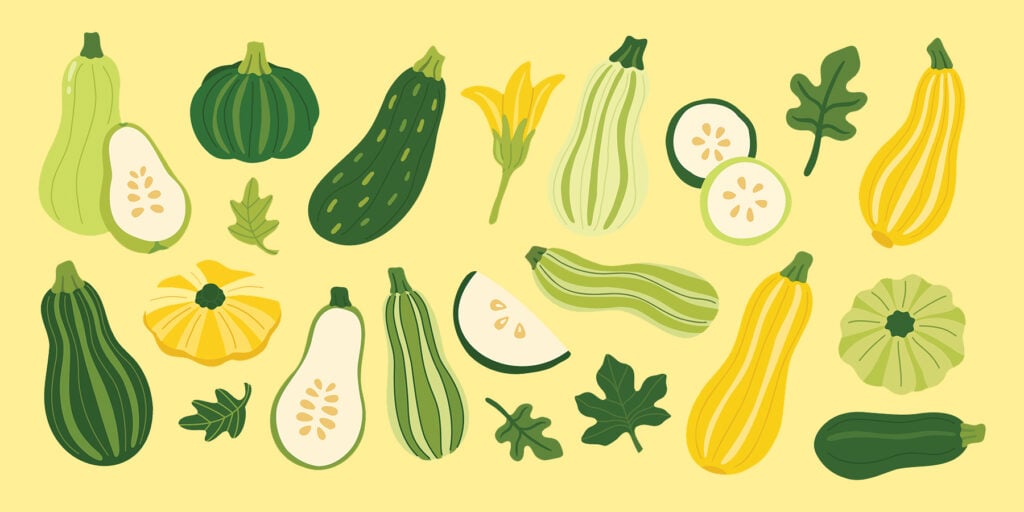
Summer squash is a delicious summer staple that includes a wide variety of types, from zucchini to chayote. Many summer squashes are varieties of the Curcubia pepo (C. pepo) species; this includes crookneck, straightneck, scallop (or pattypan), zucchini, cocozelle, and vegetable marrow, as well as 2 winter varieties, pumpkin and acorn squash. Summer varieties are typically harvested when the fruit is still immature, while the skin is thin and before the seeds harden. Contrast that with winter varieties, which are harvested when mature and have a tough skin and hard seeds.1,2 Chayote is a different species of summer squash (Sicyos edulis, also known as Sechium edule), but it is in the same taxonomic family (Cucurbitaceae) as C. pepo varieties.3
Nutrition
Summer squashes consist of about 95% water and are not nutritionally dense. However, they are a fairly good source of vitamins C and B6, providing about 20% and 6% of the recommended daily value, respectively (exact percentages vary based on squash variety).4–9
Crookneck squash. This yellow squash is characterized by its crooked neck and claviform (club-shaped) base. Its rind is covered with wart-like elevations.2 The approximate nutritional information for 100 g of crookneck squash is as follows:4
- Water: 94 g
- Calories: 19
- Protein: 1 g
- Total fat: 0 g
- Carbohydrate: 4 g
- Dietary fiber: 1 g
- Total sugars: 3 g
- Vitamin C: 19 mg
- Vitamin B6: 0.1 mg
Straightneck squash. Yellow straightneck squash is very similar to crookneck squash, with wart-like elevations on its rind, but lacking the characteristic shape of the crookneck.2 The nutritional content of these 2 varieties is the same.4
Scallop squash. Scallop squash is round, circular squash with scalloped edges—hence its name!2 A 100-g serving approximately consists of:5
- Water: 94 g
- Calories: 18
- Protein: 1 g
- Total fat: 0 g
- Carbohydrate: 4 g
- Dietary fiber: 1 g
- Total sugars: 2 g
- Vitamin C: 18 mg
- Vitamin B6: 0.1 mg
Zucchini. Zucchini is a cylindrical squash typically of uniform proportions, with little-to-no broadening.2 The approximate nutritional content of a 100-g serving is:6
- Water: 95 g
- Calories: 17
- Protein: 1 g
- Total fat: 0 g
- Carbohydrate: 3 g
- Dietary fiber: 1 g
- Total sugars: 3 g
- Vitamin C: 18 mg
- Vitamin B6: 0.2 mg
Notably, zucchini contains more B6 than other summer squashes, with a 100-g serving providing about 12% of the daily value.
Chayote. Chayote is a green, pear-shaped squash. Its nutritional content varies from that of the C. pepo varieties. While it contains slightly less vitamin C and vitamin B6, a 100-g serving provides almost 25% of your daily value of folate.10 The approximate nutritional information for a 100-g serving of chaoyte is as follows:7
- Water: 94 g
- Calories: 19
- Protein: 1 g
- Total fat: 0 g
- Carbohydrate: 5 g
- Dietary fiber: 2 g
- Total sugars: 2 g
- Vitamin C: 8 mg
- Vitamin B6: 0.08 mg
- Folate: 93 µg
Picking and preparing your squash
When shopping, select small-to-medium-sized squash (about 4 to 10 inches) with tender, firm, and glossy skin. Avoid squash with nicks, punctures, sunken areas, or moldy spots. Summer squash can be stored in the refrigerator for about 1 week.11
Properly salting summer squash is a key step in cooking them due to their high water content; the salt draws out excess water, allowing them to better absorb flavors and withstand cooking temperatures. To salt, sprinkle 0.5 to 1 tsp of kosher salt per pound of squash onto sliced squash12 (if you only have table salt, you might want to use a smaller amount, as table salt is finer than kosher salt, containing about twice the sodium per volume). Toss the vegetables in a colander and let sit for 30 minutes to 4 hours, then pat dry with paper towels.12
One of the best things about summer squash is their versatility! Eat them raw with hummus, grill them on a skewer with other vegetables, use them in baked goods like zucchini bread, broil or sauté for a tender side dish—no matter how you prepare them, you’re in for a delicious summer dish.
Sources
- Cucurbita pepo. Missouri Botanical Garden. Accessed 22 Jul 2026. https://plantfinder.mobot.org/PlantFinderDetails.aspx?taxonid=279566
- Lira Saade R, Montes Hernández S. Cucurbits. In: Hernándo Bermejo JE, León J, eds. Neglected Crops: 1492 from a Different Perspective. FAO Plant Production and Protection Series, no. 26. Food and Agriculture Organization of the United Nations; 1994:63–77. https://www.fao.org/4/t0646e/t0646e.pdf
- Sicyos edulis Jacq. Plants of the World Online – Kew Science. Accessed 22 Jul 2026. https://powo.science.kew.org/taxon/urn:lsid:ipni.org:names:293946-1
- Squash, summer, crookneck and straightneck, raw. USDA FoodData Central. 1 Apr 2019. Accessed 22 Jul 2026. https://fdc.nal.usda.gov/food-details/168464/nutrients
- Squash, summer, scallop, raw. USDA FoodData Central. 1 Apr 2019. Accessed 22 Jul 2026. https://fdc.nal.usda.gov/food-details/169289/nutrients
- Squash, summer, zucchini, includes skin, raw. USDA FoodData Central. 1 Apr 2019. Accessed 22 Jul 2026. https://fdc.nal.usda.gov/food-details/169291/nutrients
- Chayote, fruit, raw. USDA FoodData Central. 1 Apr 2019. Accessed 22 Jul 2026. https://fdc.nal.usda.gov/food-details/170402/nutrients
- Vitamin B6: fact sheet for health professionals. NIH Office of Dietary Supplements. Updated 16 Jun 2023. Accessed 22 Jul 2026. https://ods.od.nih.gov/factsheets/VitaminB6-HealthProfessional/
- Vitamin C: fact sheet for health professionals. NIH Office of Dietary Supplements. Updated 31 Jul 2025. Accessed 22 Jul 2026. https://ods.od.nih.gov/factsheets/VitaminC-HealthProfessional/
- Folate: fact sheet for health professionals. NIH Office of Dietary Supplements. Updated 30 Nov 2022. Accessed 22 Jul 2026. https://ods.od.nih.gov/factsheets/Folate-HealthProfessional/
- Andersen K. Summer squash. Montana State University Extension. Nov 2015. Accessed 22 Jul 2026. https://www.montana.edu/extension/buyeatlivebetter/main_documents/factsheets/msu_extension_food_fact_sheets/SummerSquash.FFSpdf.pdf
- White C. Why you should salt watery vegetables before cooking. America’s Test Kitchen. 8 Dec 2021. Accessed 22 Jul 2026. https://www.americastestkitchen.com/articles/4102-why-you-should-salt-watery-vegetables-before-cooking