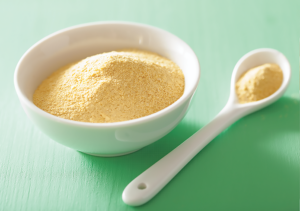
 Nutritional yeast is similar to that used in baking or brewing
(Saccharomyces cerevisiae), except that it has been deactivated. It is popular in vegan cooking due to its Parmesan cheese-like flavor. But its overall savory taste, which many have described as umami (the “fifth taste”), goes beyond cheesy, making it a versatile culinary seasoning for dishes of all types.¹˒²
Nutritional yeast isn’t just a tasty seasoning, though. Available in powder, flakes, or granules, it provides all nine essential amino acids, making it a complete protein. Two tablespoons provide eight grams of protein and four grams of fiber. It is considered a low-glycemic food and also provides several trace minerals, including chromium, iron, selenium, manganese, and molybdenum.² Fortified nutritional yeast, in particular, is an excellent source of the B vitamins (B2, B3, B6, B9, and B12), making it a healthy addition to a vegan diet, in which vitamin B12 is especially lacking.² Nutritional yeast has many other potential health benefits.
Quick Facts
| Category | Details |
| Food Type | Deactivated Saccharomyces cerevisiae |
| Available Forms | Powder, flakes, granules |
| Flavor Profile | Savory, umami, Parmesan-like |
| Protein Content | 8g per two tablespoons; complete protein (all 9 essential amino acids) |
| Fiber Content | 4g per two tablespoons (~20% DV) |
| Key Vitamins | B2, B3, B6, B9, B12 (fortified products) |
| Notable B12 Content | 313% DV per two teaspoons (fortified) |
| Key Minerals | Chromium, iron, selenium, manganese, molybdenum, zinc |
| Glycemic Impact | Low-glycemic |
| Primary Health Benefits Covered | Heart health, immune support, physical recovery, fatigue reduction |
| Key Precautions | Not recommended for those with yeast/mold allergies, gout, kidney stones, Crohn’s disease, celiac disease, atopic dermatitis, or those taking MAO inhibitors |
Potential Benefits
Research suggests that nutritional yeast may offer a range of health benefits, from cardiovascular and immune support to improved physical recovery and sustained energy. The following breaks down what the current evidence shows.
Heart Health
Nutritional yeast contains beta-glucan, a form of soluble fiber that has been shown to help reduce risk factors associated with heart disease, including:⁴
- High cholesterol
- Obesity
- High blood pressure
- Atherosclerosis
- Oxidative stress
Diabetes is another risk factor associated with heart disease, and fortified nutritional yeast and brewer’s yeast contain chromium, a mineral that, like beta-glucan, plays an essential role in regulating blood sugar levels and insulin metabolism.⁵
The glutathione in nutritional yeast is a powerful antioxidant that also supports a healthy heart. Glutathione is a polypeptide that protects cells against free radicals and pro-oxidants and maintains oxidant-antioxidant homeostasis within the cells.⁶
Immune System Functioning
Nutritional yeast contains selenomethionine, a naturally occurring form of the mineral selenium. Selenomethionine combines with proteins in the body to form the antioxidant selenoprotein, which plays a critical role in regulating immune cell functioning.7
The beta-glucan in nutritional yeast also plays an important role in immune system functioning.8 Beta-glucan acts as an effective immunomodulator and enhances the anti-tumoral activity of macrophages in the lining of the abdominal cavity.8 Beta-glucan has also been shown to elicit broad antimicrobial effects against:
- Staphylococcus aureus
- Escherichia coli
- Candida albicans
- Pneumocystis carinii
- Listeria monocytogenes
- Leishmania donovani
- and influenza virus.8
In plain English, this means nutritional yeast may help support the immune system’s normal defense response against certain bacteria, fungi, and viruses associated with common infections.
Physical Recovery
The beta-glucan in nutritional yeast has been shown to have a positive effect on muscle tissue recovery, fatigue recovery time, and endurance in athletes. Researchers believe that beta-glucan promotes the aerobic capacity of the body, but how this is achieved is unclear. It has been suggested that beta-glucan’s regulating effects on blood urea nitrogen, lactic acid, and creatine may be involved.9
One study found that athletes who consumed 250mg/day of beta-glucan derived from baker’s yeast had greater concentrations of plasma immune response markers and shorter recovery periods following strenuous activity compared to the athletes who consumed the placebo.10
Nutritional yeast also contains zinc, a trace mineral involved in the body’s response to oxidative stress, homeostasis, immune system functioning, deoxyribonucleic acid (DNA) replication, DNA damage repair, and cell cycle progression. Zinc also helps in muscle repair and regeneration due to its role in the synthesis of protein and collagen.11
Fighting Fatigue
Fortified nutritional yeast is an excellent source of vitamins B2, B3, B6, B9, and B12. In fact, two teaspoons of fortified nutritional yeast provides:²
- 246% DV for riboflavin (B2)
- 109% DV for niacin (B3)
- 212% DV for pyridoxine (B6)
- 59% DV for folate (B9)
- 313% DV for cobalamin (B12)
Vitamin B12, along with the other B vitamins, is required for the creation of cellular energy from dietary fats and proteins. B12 is also involved in the production of hemoglobin, and a deficiency in B12 can lead to hemoglobin-deficient anemia. Those who are deficient in the B vitamins, especially B12, may experience symptoms of chronic fatigue and weakness.¹² Nutritional yeast is a tasty way to ensure you’re getting enough of the B vitamins in your diet.
Potential Risks
While nutritional yeast is generally considered safe for most people, side effects may occur in sensitive individuals, those on certain medications, and those with certain medical conditions. The warnings below are for baker’s, brewer’s, and nutritional yeast products.
Tyramine, Headaches & MAO Inhibitor Interactions
Dietary yeast contains tyramine, an amino acid that plays a role in blood pressure regulation.¹³ Tyramine may trigger headaches or migraines in susceptible individuals. Tyramine can also interact negatively with certain medications, such as monoamine oxidase inhibitors.¹³ Individuals who are susceptible to headaches or migraines and people on monoamine oxidase inhibitors should consult with their physicians before consuming yeast.
Yeast or Mold Allergies & Atopic Dermatitis
People with yeast or mold allergies should not consume yeast. Additionally, research has shown an association between atopic dermatitis and yeast sensitivity; thus, individuals with atopic dermatitis should not consume yeast.¹⁴⁻¹⁸
Ochratoxin A Contamination
Dietary yeast products are at risk of being contaminated with ochratoxin A, a mycotoxin that can harm the kidneys. While this has only been reported in brewer’s yeast samples, it is important to choose lab-tested dietary yeast products from trusted manufacturers.¹⁴˒¹⁹˒²⁰
Kidney Stones & Gout
Dietary yeast products are high in uric acid and its precursor purine. Therefore, individuals with kidney stones or gout should not consume dietary yeast products.¹⁴˒²¹˒²²
Celiac Disease & Crohn’s Disease
People with celiac disease or Crohn’s disease may have antibodies to S. cerevisiae, the fungus used to make yeast. Therefore, consuming yeast products may aggravate disease symptoms. Consult with a physician before consuming yeast.¹⁴˒²³˒²⁴
Gastrointestinal Discomfort
Nutritional yeast provides about 20 percent DV of fiber, which may cause gastrointestinal discomfort in individuals who are not used to consuming a lot of fiber. For these people, starting with a smaller portion and drinking lots of water may help.²
Editor’s Note
Fortified and unfortified nutritional yeast products can vary in a number of ways, from manufacturing process, to the amount and type of nutrients added, to the type of fungus from which the yeast was derived (though most come from S. cerevisiae). Thus, it is important to read the labels carefully to find the nutritional yeast product best for you. Consult with your physician before incorporating nutritional yeast into your diet.
Sources
- Hacket J. What is nutritional yeast? 9 Sep 2022. The Spruce Eats website. https://www.thespruceeats.com/what-is-nutritional-yeast-3376833. Accessed 27 Nov 2023.
- Panoff L. Is nutritional yeast healthy? All you need to know. 8 Mar 2023. Healthline website. https://www.healthline.com/nutrition/nutritional-yeast. Accessed 27 Nov 2023.
- WebMD Editorial Contributors. Nutritional yeast: is it good for you? 14 Sep 2022. Nourish by WebMD website. https://www.webmd.com/diet/nutritional-yeast-good-for-you. Accessed 28 Nov.
- Wouk J, Dekker RFH, Queiroz EAIF, Barbosa-Dekker AM. β-Glucans as a panacea for a healthy heart? Their roles in preventing and treating cardiovascular diseases. Int J Biol Macromol. 2021;177:176–203.
- Cefalu WT, Hu FB. Role of chromium in human health and in diabetes. Diabetes Care. 2004;27(11):2741–2751. Erratum in: Diabetes Care. 2013 Sep;36(9):2872.
- Averill-Bates DA. The antioxidant glutathione. Vitamins and Hormones. 2023;121:109–141.
- Avery JC, Hoffmann PR. Selenium, selenoproteins, and immunity. Nutrients. 2018;10(9):1203.
- Akramiene D, Kondrotas A, Didziapetriene J, Kevelaitis E. Effects of beta-glucans on the immune system. Medicina (Kaunas). 2007;43(8):597–606.
- Wang R, Wu X, Lin K, et al. Plasma metabolomics reveals β-glucan improves muscle strength and exercise capacity in athletes. Metabolites. 2022;12(10):988.
- Carpenter KC, Breslin WL, Davidson T, et al. Baker’s yeast β-glucan supplementation increases monocytes and cytokines post-exercise: implications for infection risk? Br J Nutr. 2013;109(3):478–486.
- Chasapis CT, Ntoupa PA, Spiliopoulou CA, Stefanidou ME. Recent aspects of the effects of zinc on human health. Arch Toxicol. 2020;94(5):1443–1460.
- Jacques J (ed). Vitamin B12 (Cobalamin). In: Micronutrition for the Weight Loss Surgery Patient. West Chester, PA: Matrix Medical Communications; 2006:47–55.
- Burns C, Kidron A. Biochemistry, tyramine. Last Update: October 10, 2022. StatPearls [Internet]. Treasure Island (FL): StatPearls Publishing; 2023 Jan-. https://www.ncbi.nlm.nih.gov/books/NBK563197/. Accessed 28 Nov 2023.
- Ristic A. Nutritional yeast: benefits, nutrition facts & dangers. Last updated: 9 Sep 2021. SelfDecode website. https://supplements.selfdecode.com/blog/nutritional-yeast/. Accessed 28 Nov 2023.
- Koivikko A, Kalimo K, Nieminen E, et al. Allergenic cross-reactivity of yeasts. Allergy. 1988;43(3):192–200.
- Pajno GB, Passalacqua G, Salpietro C, et al. Looking for immunotolerance: a case of allergy to baker’s yeast (Saccharomyces cerevisiae). Eur Ann Allergy Clin Immunol. 2005;37(7):271–272.
- Kortekangas-Savolainen O, Lammintausta K, Kalimo K. Skin prick test reactions to brewer’s yeast (Saccharomyces cerevisiae) in adult atopic dermatitis patients. Allergy. 1993;48(3):147–150.
- Savolainen J, Kortekangas-Savolainen O, Nermes M, et al. IgE, IgA, and IgG responses to common yeasts in atopic patients. Allergy. 1998;53(5):506–512.
- Gottschalk C, Biermaier B, Gross M, et al. Ochratoxin A in brewer’s yeast used as food supplement. Mycotoxin Res. 2016;32(1):1–5.
- Bui-Klimke TR, Wu F. Ochratoxin A and human health risk: a review of the evidence. Crit Rev Food Sci Nutr. 2015;55(13):1860–1869.
- Hafez RM, Abdel-Rahman TM, Naguib RM. Uric acid in plants and microorganisms: biological applications and genetics – a review. J Adv Res. 2017;8(5):475–486.
- Costantini AV. The fungal etiology of gout and hyperuricemia: the antifungal mode of action of colchicine. Bio Medical Rev. 1992;1:47–52. https://journals.mu-varna.bg/index.php/bmr/article/view/221/221. Accessed 28 Nov 2023.
- Barta Z, Csípö I, Antal-Szalmás P, Set al. Saccharomyces cerevisiae elleni antitest elófordulása Crohn-betegségben [Anti-Saccharomyces cerevisiae antibodies in patients with Crohn’s disease]. Orv Hetil. 2001;142(42):2303–2307. Hungarian.
- Barta Z, Csípõ I, Szabó GG, Szegedi G. Seroreactivity against Saccharomyces cerevisiae in patients with Crohn’s disease and celiac disease. World J Gastroenterol. 2003;9(10):2308–2312.