By Sarabeth Lowe, MPH
Ms. Lowe is a Communication Specialist at the University of Delaware Disaster Research Center.
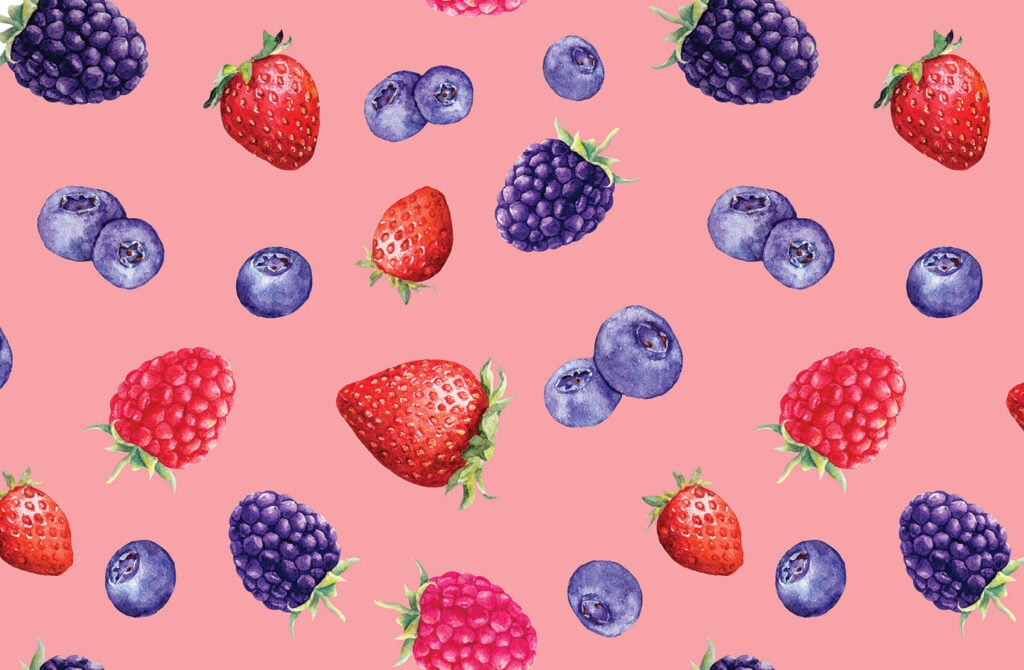
Whether they are baked into a pie, sprinkled on top of oatmeal, or eaten by the bucket, berries are some of the most versatile foods on the planet. Hundreds of edible berry species exist across the world, and their unique texture, tart flavor, and bright colors have made them a cultural and culinary staple for thousands of years.1,2 In the last 2 decades, the popularity of and attention toward these fruits has increased as research continues to shed light on their health benefits.3 As summer approaches, marking peak berry season, here’s what you need to know.
What Is a Berry?
What do pumpkins, bananas, and pomegranates all have in common? It might surprise you that these are all berries and that some of the tried-and-true iconic names are not.4–7 The scientific and colloquial definitions of this fruit are not the same. The botanical definition is much more precise and based on how a plant’s flower and adjoining parts develop into fruit—not on its taste or appearance.6 “True berries” are simple fleshy fruits that stem from 1 flower with 1 ovary and typically have several seeds inside of them. Strawberries and raspberries aren’t true berries because they are derived from a single flower with more than 1 ovary.5 In this article, “berries” refers to small, soft, and colored fruits that are typically associated with the term.
Berries by the Numbers: Nutrition at a Glance
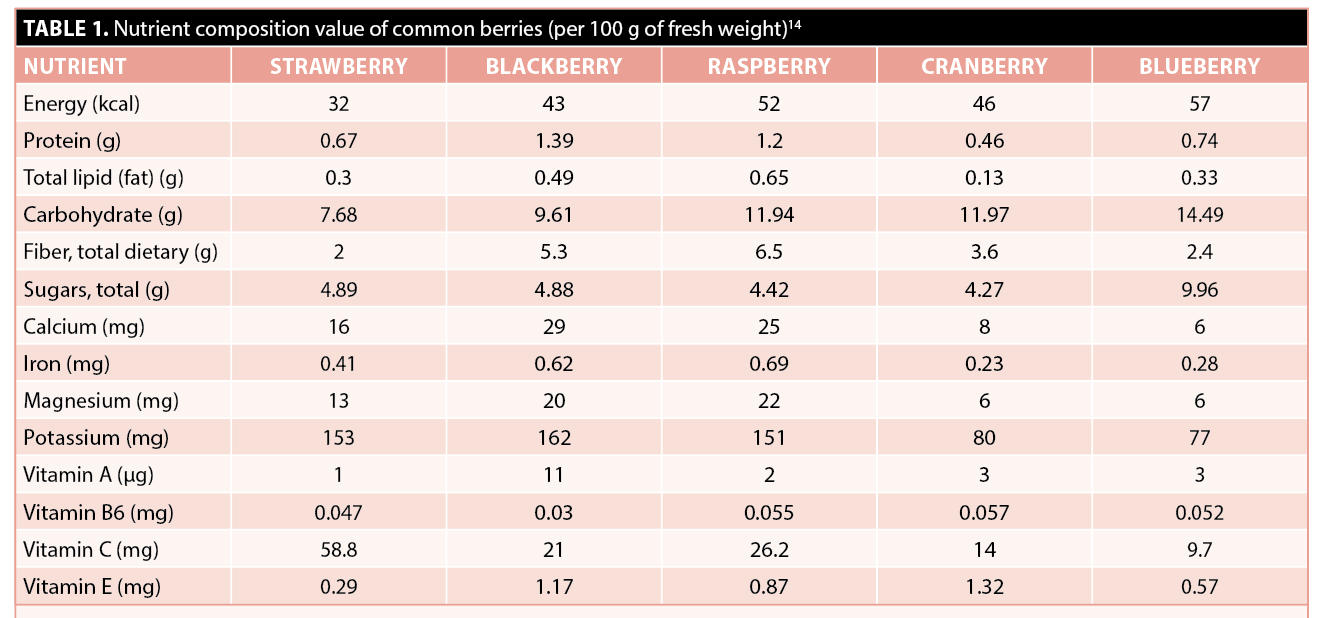
Berries pack a big punch when it comes to their nutritional value, making them one of the healthiest foods on the market. They are top sources of vitamins, minerals, and other essential nutrients, including potassium, magnesium, vitamins C and K, and fiber.8–14 At the same time, they are relatively low in calories, carbohydrates, and natural sugars (Table 1).
Health Benefits: Antioxidants
Berries are nutritional powerhouses, but their main claim to fame is their antioxidant content.12,14–16 The antioxidant capacity of berries is 4 times higher than that of other fruits and 10 times higher than that of vegetables.14 In fact, blueberries, blackberries, and raspberries have some of the highest antioxidant activity of commonly consumed fruits.14 This might be due to the presence of anthocyanins, which confer the blue, purple, and red colors of many fruits.14,15,17 Anthocyanins are known to be one of the most powerful natural antioxidants, and berries are one of the richest sources of them among all fruits.17–19
Why is this so important? Antioxidants help your body fight off free radicals, unstable molecules in the body. Free radicals play an important and essential role in human health, but can damage your cells at high levels.15,20–23 When free radicals outnumber antioxidants, it can lead to oxidative stress, which causes damage to deoxyribonucleic acid (DNA), cells, and tissues. This imbalance can lead to a range of negative health outcomes and chronic conditions, including cancer, stroke, degenerative disorders, and metabolic and cardiovascular disease.11,23 It can also lead to chronic inflammation, another condition that has been linked to numerous negative health outcomes, and early signs of aging.17,22
Shopping and Storage
Though berries can be bought year-round in many supermarkets, the season starts in the spring and peaks in the summer.24 However, berries are highly perishable—and expensive. When selecting berries at the grocery store, aim to purchase a container with ones that are firm, plump, and free of discoloration. To fully reap the health benefits of berries, the most important step is washing them, as research shows they are at high risk of contamination from pesticides and disease-causing microorganisms during their journey from farm to fork.25,26
Each year, the Environmental Working Group, an environmental advocacy organization, publishes an annual list of fruits and vegetables and ranks them as the most and least “pesticide-contaminated” produce commodities sold in the United States.25–27 In this year’s “Dirty Dozen,” which analyzed 47 types of produce, strawberries, blackberries, and blueberries top the list as the third, ninth, and twelfth most contaminated items, respectively.28 Notably, some food safety scientists and industry experts have scrutinized this list due to apparent gaps in its ranking methodology and unfairly demonizing certain types of produce. Still, the point stands: carefully and thoroughly wash berries before eating them.
Locally grown berries are typically the freshest, so now is the time to dig in! If you’re looking to get outside this summer, berry picking can be a fun, family-friendly activity. Just be sure to do so safely, especially if you choose to forage in the wild. Adhere to any local regulations, avoid harvesting in polluted areas, and brush up on your plant identification skills or consult an expert to make sure the berries are safe and nontoxic; never consume berries that you have not identified as safe to eat with 100% certainty.1,29–32
Sources
- Bellows AC, Raj S, Pitstick E, et al. Foraging wild edibles: dietary diversity in expanded food systems. Nutrients. 2023;15(21):4630.
- Aguilera JM, Toledo T. Wild berries and related wild small fruits as traditional healthy foods. Crit Rev Food Sci Nutr. 2024;64(16):5603–5617.
- Palmer-Rubin B. The berry revolution: non-traditional agriculture and economic opportunity in Mexico. ReVista: Harvard Review of Latin America. 25 Feb 2024. Accessed 28 May 2026. https://revista.drclas.harvard.edu/the-berry-revolution-non-traditional-agriculture-and-economic-opportunity-in-mexico/
- McVean, Lee C. Bananas are berries. Raspberries are not. McGill University Office for Science and Society. 6 Dec 2017. Accessed 28 May 2026. https://www.mcgill.ca/oss/article/did-you-know/bananas-are-berries-raspberries-are-no
- Lorge G. Bananas are berries? Stanford Magazine. 1 Jul 2023. Accessed 28 May 2026. https://stanfordmag.org/contents/bananas-are-berries
- What makes a berry a berry? University of California Agriculture and Natural Resources. 31 Aug 2024. Accessed 28 May 2026. https://ucanr.edu/blog/napa-master-gardener-column/article/what-makes-berry-berry
- Aguilera JM. Berries as Foods: Processing, products, and health implications. Annu Rev Food Sci Technol. 2024;15:1–26.
- Jain S, Sivapragasam N, Maurya A, et al. Edible berries – an update on nutritional composition and health benefits – part I. Curr Nutr Rep. 2025;14(1):7.
- Thorakkattu P, Jain S, Sivapragasam N, et al. Edible berries – an update on nutritional composition and health benefits – part II. Curr Nutr Rep. 2025;14(1):10.
- Sivapragasam N, Maurya A, Tiwari S, et al. Edible berries – an update on nutritional composition and health benefits – part III. Curr Nutr Rep. 2025;14(1):11.
- Martini D, Marino M, Del Bo’ C. Berries and human health: mechanisms and evidence. Nutrients. 2023;15(11):2527.
- Barkaoui S, Madureira J, Boudhrioua N, Cabo Verde S. Berries: effects on health, preservation methods, and uses in functional foods: a review. Eur Food Res Technol. 2023;249(7):1689–1715.
- Yang B, Kortesniemi M. Clinical evidence on potential health benefits of berries. Curr Opin Food Sci. 2015;2:36–42.
- Golovinskaia O, Wang CK. Review of functional and pharmacological activities of berries. Molecules. 2021;26(13):3904.
- de Souza VR, Pereira PAP, da Silva TLT, et al. Determination of the bioactive compounds, antioxidant activity, and chemical composition of Brazilian blackberry, red raspberry, strawberry, blueberry, and sweet cherry fruits. Food Chem. 2014;156:362–368.
- Halvorsen BL, Holte K, Myhrstad MCW, et al. A systematic screening of total antioxidants in dietary plants. J Nutr. 2002;132(3):461–471.
- Olas B. Berry phenolic antioxidants – implications for human health? Front Pharmacol. 2018;9:78.
- Lee SG, Vance TM, Nam TG, et al. Contribution of anthocyanin composition to total antioxidant capacity of berries. Plant Foods Hum Nutr. 2015;70(4):427–432.
- He J, Giusti MM. Anthocyanins: natural colorants with health-promoting properties. Annu Rev Food Sci Technol. 2010;1:163–187.
- Arnarson A. Antioxidants explained in simple terms. Healthline. 12 Jul 2023. Accessed 29 May 2026. https://www.healthline.com/nutrition/antioxidants-explained
- Definition of antioxidant. National Cancer Institute. Updated 2 Feb 2011. Accessed 29 May 2026. https://www.cancer.gov/publications/dictionaries/cancer-terms/def/antioxidant
- Rahal A, Kumar A, Singh V, et al. Oxidative stress, prooxidants, and antioxidants: the interplay. BioMed Res Int. 2014;2014:761264.
- Dai X, Huang Z, Lyu R. Free radicals in health and disease. MedComm. 2025;6(10):e70396.
- Seasonal produce guide. US Department of Agriculture. Accessed 30 May 2026. https://snaped.fns.usda.gov/resources/nutrition-education-materials/seasonal-produce-guide
- Henderson B. EWG publishes 2026 ‘Dirty Dozen’ list of “pesticide-contaminated” produce – but is it scientifically sound? Food Safety Magazine. 24 Mar 2026. Accessed 30 May 2026. https://www.food-safety.com/articles/11266-ewg-publishes-2026-dirty-dozen-list-of-pesticide-contaminated-producebut-is-it-scientifically-sound
- Winter CK, Katz JM. Dietary exposure to pesticide residues from commodities alleged to contain the highest contamination levels. J Toxicol. 2011;2011:589674.
- Jacobs N, Kougias DG, Louie F, Roberts B. A screening-level human health risk assessment of dietary intake of pesticide residues in produce as compared to consumer guide recommendations. Crit Rev Toxicol. 2024;54(4):215–234.
- EWG’s shooper guide: the 2026 Dirty Dozen™. Environmental Working Group. Accessed 30 May 2026. https://www.ewg.org/foodnews/dirty-dozen.php
- Colella L. The art of modern foraging. Sierra Club. 20 Jul 2023. Accessed 30 May 2026. https://www.sierraclub.org/sierra/2023-2-summer/material-world/art-modern-foraging
- Foraging: what to avoid. Cleveland Clinic. 12 May 2026. Accessed 30 May 2026. https://health.clevelandclinic.org/foraging-101-what-to-eat-and-avoid
- Linnekin BJ. Food law gone wild: the law of foraging. Fordham Urban Law J. 2018;45(4).
- Lord B. A beginner’s guide to foraging etiquette. The Center for Northern Woodlands Education. 1 Dec 2023. Accessed 30 May 2026. https://northernwoodlands.org/articles/article/foraging-etiquette