
By Sarabeth Lowe, MPH
Ms. Lowe is a Communication Specialist at the University of Delaware Disaster Research Center.
The health impacts of climate change are well established. Researchers have long documented the direct, deadly impacts of global warming, such as laborers succumbing to heat exhaustion or people drowning in flood waters. However, a growing body of research is shedding light on the various indirect and far-reaching ways climate change affects health. One of these more subtle pathways is its impact on food security.1–4
What is food security?
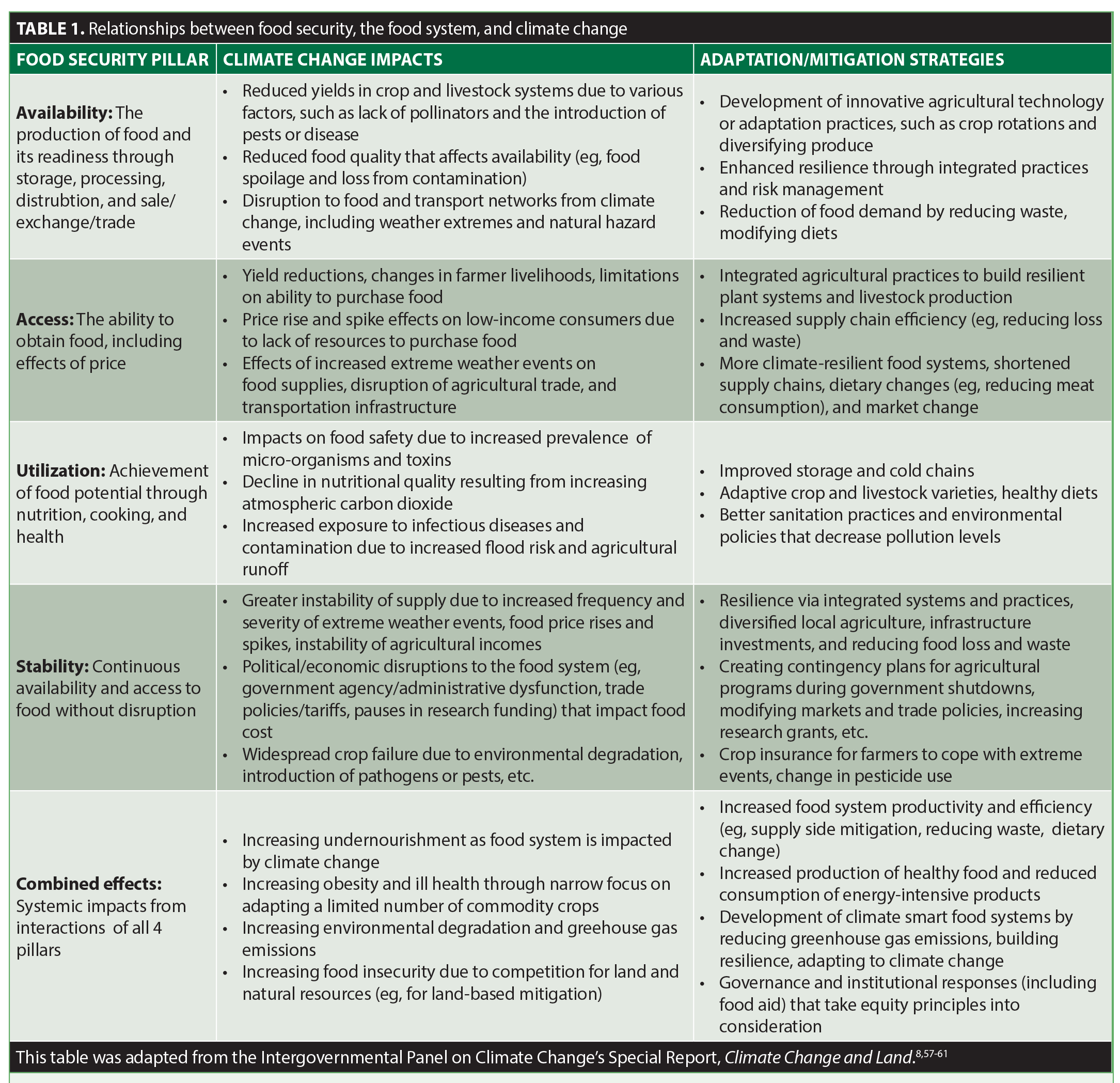
According to the World Bank Group, food security is achieved when “all people, at all times, have physical and economic access to sufficient safe and nutritious food that meets their dietary needs and food preferences for an active and healthy life.”6 The United States Department of Agriculture echoes this sentiment, defining food insecurity as “limited or uncertain availability of nutritionally adequate and safe foods” or the “ability to acquire acceptable foods in socially acceptable ways.”6,7 Notably, food security is multifaceted with 4 main pillars (Table 1).5,8,9 Availability is the “supply” side of food security, such as levels of production and stock. Access means having equitable, unrestricted, and regular access to food; this can be impacted by the presence of food deserts, income, socioeconomic status, and food prices. Utilization involves the biological (ie, how your body uses the nutrients in your food, supporting your overall health and wellbeing) and logistical (eg, food preparation, diet diversity, and intrahousehold distribution, etc.) facets of food utilization. The fourth pillar is stability. Food insecurity isn’t static and can change over time in response to shifts in these 3 dimensions. Some of these specific factors include weather conditions, political instability, and economic factors (eg, unemployment, rising food prices).5,8,9
It’s difficult to overstate how tightly intertwined food security and climate change are. From farm to fork, various climatic factors, including drought, sea-level rise, and higher temperatures, affect the availability, quality, and affordability of crops and livestock that support our diet.4,9–11 Furthermore, the interactions between climate change and food systems are reciprocal and cyclical, meaning that their impacts go both ways; the function of our global food system is both a major driver of climate change and increasingly vulnerable to it.8–13 For example, natural hazards and extreme weather patterns related to climate change threaten the viability of agricultural practices, supply chains, and crop and livestock resilience.9
How does climate change affect food security?
Crop yield. Increasing temperatures have wide-ranging impacts on food yields and production, especially as they relate to the damage and destruction of crops. The food system contributes more than 30% of the heat-trapping gases emitted by human activities globally each year.9,14 Though previous studies have suggested that climate change may lead to crop yield increases in some temperate regions in the near term, new research shows that increasing temperatures will decrease food production in the long term.9,15–18 Results from a 2025 study published in Nature suggest that every additional degree Celsius of global warming will decrease the world’s ability to produce food by 120 calories per person per day.16,17 For context, that’s about 4.4% of daily consumption. Research also shows that climate change will decrease the production of key heritage foods and staple crops, such as corn, maize, rice, and wheat.1,8,9,11–13,18
Livestock production is another component of our food system that has a negative environmental impact. It is also one of the leading industrial contributors to greenhouse gases, accounting for an estimated 14% to 18% of global emissions.8,19–21 The distribution of land use between the livestock and farming sectors is skewed, with some estimates showing that nearly 80% of the former is used to support domestic animal farms.19–21 This imbalance only worsens the other environmental impacts of the livestock industry, including deforestation, land degradation, soil erosion, natural resource depletion, biodiversity loss, and air, water, and land pollution from animal waste and industrial farm runoff.8,9,12,20,22–26 These downstream consequences contribute to food insecurity in several indirect ways, such as food quality and water contamination.
Biodiversity. Several current agricultural practices undermine biodiversity, an important pillar of achieving food security.9,26–28 According to the United Nations Food and Agriculture Organization, agriculture drives almost 90% of global deforestation, a significant driver of habitat loss and, thus, plant diversity and species extinction.28,29 At the same time, the land being cleared to grow crops often employs monoculture farming (ie, planting a single crop species, such as corn, over large areas of land for consecutive seasons).28,30 Today, only a handful of plant species, including rice, wheat, and maize, account for the vast majority of global crop production.28,31–33 This reliance on a narrow set of crops undermines our food system’s resilience and makes it extremely vulnerable to pests, pathogens, and climate extremes. An example of this is the 19th-century Irish potato famine, when reliance on a single crop with low genetic variation led to catastrophic agricultural losses due to disease.28,34–36
Biodiversity is a natural buffer against environmental changes. For example, greater plant diversity can help compensate for fluctuations in other crop yields, enhance ecosystem resilience, improve soil health, and attract more pollinators, which support and strengthen the growth of other important crops.28,36,37 A variety of animals, including insects, livestock, fish, and ruminants, also support food security. While they are important sources of meat, other animal byproducts, such as eggs and milk, also support a balanced diet and provide numerous critical micronutrients.37–39
Nutrient content. Climate change has spurred environmental conditions that have decreased the nutritional value and safety of certain crops.1–3,8,9,11–14,40–45 A groundbreaking meta-analysis published in 2025 looked at 32 nutrients across 43 different crops and found that rising levels of carbon dioxide (CO2) in the atmosphere caused a clear shift in plant composition across a wide range of species.41,42 Higher CO2 levels have increased plants’ carbon uptake, which increases the amount of carbohydrates, like sugars and starch, while decreasing the amount of protein and critical nutrients, such as iron and zinc. Put simply, each bite of food is becoming comparatively higher in calories but lower in nutrients.
This widespread decline in plant nutrient content introduces a more subtle impact of climate change on human health: nutrient insecurity. This term describes the nutritional adequacy of your diet (ie, how well your food helps you meet the recommended dietary allowances/adequate intake of vitamins and minerals).46–49 Improving access to nutritious foods can help manage, prevent, and treat certain health conditions. On the other hand, micronutrient deficiencies can lead to numerous negative health outcomes, including malnutrition, adverse pregnancy outcomes, and increased susceptibility to infectious diseases. These cases of hidden hunger are already a pervasive problem; more than half of the world’s population is not meeting basic micronutrient requirements.40,50,51
The Future of Our Food Systems
Our food system is directly affected by both long-term climatic shifts and more frequent or intense extremes, and their consequences ripple across the food chain.4 These impacts are not far off or abstract. Even minuscule changes in temperature have been shown to increase food prices.4,52,53 Furthermore, climate change is expected to decrease crop yields by 8% in 2050, regardless of how much greenhouse gas emissions rise or fall.16,17,54,55 Whether it’s the introduction of deadly plant and animal pathogens or more cases of heat-related illness among agricultural workers, adaptation can’t outrun climate change.
Even if we cannot halt climate change in its tracks, there is hope for mitigating its effect on food security. We can transform how we grow food and what we eat, rather than letting climate change dictate the pace of change.56 Taking advantage of local food systems, such as buying groceries from your city’s farmer’s market or picking your produce at an orchard, can feel empowering while lowering your carbon footprint. More evidence-based decision-making at the political and industrial levels can enable farmers to adopt innovative agricultural technologies and practices that orchestrate larger-scale changes to help make our food system more resilient. This doesn’t have to be a story of abstinence or restriction. All of these actions, whether at the macro or micro levels, will have a ripple effect across our food system and impact one of the most basic human rights and a fundamental pillar of health: fair and equitable access to nutritious food.
Sources
- Climate changes health: food and agriculture. American Public Health Association. Accessed 10 Mar 2026. https://www.apha.org/topics-and-issues/climate-health-and-equity/agriculture
- Food security. US Centers for Disease Control and Prevention. Updated 2 Mar 2024. Accessed 10 Mar 2026. https://www.cdc.gov/climate-health/php/effects/food-security.html
- Brown ME, Antle JM, Backlund P, et al. Climate change, global food security, and the US food system – complete report. US Department of Agriculture. Dec 2015. Accessed 10 Mar 2026. https://www.usda.gov/sites/default/files/documents/FullAssessment.pdf
- Climate change and food prices. Climate Central. 19 Nov 2025. Accessed 10 Mar 2026. https://www.climatecentral.org/climate-matters/climate-change-and-food-prices
- What is food security? World Bank Group. Accessed 12 Mar 2026. https://www.worldbank.org/en/topic/agriculture/brief/food-security-update/what-is-food-security
- Food security in the US – key statistics & graphics. US Department of Agriculture – Economic Research Service. Updated 18 Feb 2026. Accessed 12 Mar 2026. https://www.ers.usda.gov/topics/food-nutrition-assistance/food-security-in-the-us/key-statistics-graphics
- Food security in the US – measurement. US Department of Agriculture – Economic Research Service. Updated 18 Feb 2026. Accessed 17 Mar 2026. https://www.ers.usda.gov/topics/food-nutrition-assistance/food-security-in-the-us/measurement
- Mbow C, Rosenzweig C, Barioni LG, et al. Food security. In: Shukla PR, Skea J, Calvo Buendia E, et al, eds. Climate Change and Land: an IPCC special report on climate change, desertification, land degradation, sustainable land management, food security, and greenhouse gas fluxes in terrestrial ecosystems. Cambridge University Press; 2022:437–550.
- Sandalow D, Rosenzweig C, Hayek M, et al. Food and climate change infoguide. Columbia University Center on Global Energy Policy. 3 May 2021. Accessed 17 Mar 2026. https://www.energypolicy.columbia.edu/publications/food-and-climate-change-infoguide/
- Actors of the food system. United Nations Food Systems Coordination Hub. Accessed 17 Mar 2026. https://openknowledge.fao.org/server/api/core/bitstreams/23a46066-a7b4-45cc-8ec4-cdec7609d18e/content/food-systems-toolkit-2025/questions-3.html
- Fanzo J, Carducci B, Louis-Jean J, et al. Climate change, extreme weather events, food security, and nutrition: evolving relationships and critical challenges. Annu Rev Nutr. 2025;45(1):335–360.
- Owino V, Kumwenda C, Ekesa B, et al. The impact of climate change on food systems, diet quality, nutrition, and health outcomes: a narrative review. Front Clim. 2022;4:941842.
- Mirzabaev A, Kerr RB, Hasegawa T, et al. Severe climate change risks to food security and nutrition. Clim Risk Manag. 2023;39:100473.
- Tubiello FN, Rosenzweig C, Conchedda G, et al. Greenhouse gas emissions from food systems: building the evidence base. Environ Res Lett. 2021;16(6):065007.
- Challinor AJ, Watson J, Lobell DB, et al. A meta-analysis of crop yield under climate change and adaptation. Nature Clim Change. 2014;4:287–291.
- Garthwaite J. Climate change cuts global crop yields, even when farmers adapt. Stanford Doerr School of Sustainability. 18 Jun 2025. Accessed 20 Mar 2026. https://sustainability.stanford.edu/news/climate-change-cuts-global-crop-yields-even-when-farmers-adapt
- Hultgren A, Carleton T, Delgado M, et al. Impacts of climate change on global agriculture accounting for adaptation. Nature. 2025;642(8068):644–652.
- Tran BL, Tseng WC, Chen CC. Climate change impacts on crop yields across temperature rise thresholds and climate zones. Sci Rep. 2025;15(1):23424.
- Ritchie H. 50% of all land in the world is used to produce food. World Economic Forum. 11 Dec 2019. Accessed 20 Mar 2026. https://www.weforum.org/stories/2019/12/agriculture-habitable-land/
- Meat’s environmental impact. Stanford Woods Institute for the Environment. 21 Nov 2025. Accessed 20 Mar 2026. https://woods.stanford.edu/news/meats-environmental-impact
- Eisen MB, Brown PO. Rapid global phaseout of animal agriculture has the potential to stabilize greenhouse gas levels for 30 years and offset 68 percent of CO2 emissions this century. PLOS Clim. 2022;1(2):e0000010.
- Steinfeld H, Gerber P, Wassenaar T, et al. Livestock’s Long Shadow: Environmental Issues and Options. FAO; 2006.
- Godde CM, Mason-D’Croz D, Mayberry DE, et al. Impacts of climate change on the livestock food supply chain: a review of the evidence. Glob Food Sec. 2021;28:100488.
- Ilea RC. Intensive livestock farming: global trends, increased environmental concerns, and ethical solutions. J Agric Environ Ethics. 2009;22:153–167.
- Eshel G, Shepon A, Makov T, Milo R. Land, irrigation water, greenhouse gas, and reactive nitrogen burdens of meat, eggs, and dairy production in the United States. Proc Natl Acad Sci U S A. 2014;111(33):11996–12001.
- Pereira P, Inacio M, Barcelo D, Zhao W. Impacts of agriculture intensification on biodiversity loss, climate change and ecosystem services. Curr Opin Environ Sci Health. 2025;46;100367.
- Coutinho AB. No biodiversity – no future for food, or why we need more nature in agriculture. DevelopmentAid. 13 Jul 2023. Accessed 22 Mar 2026. https://www.developmentaid.org/news-stream/post/164569/no-biodiversity-no-future-for-food
- Elouafi I. Why biodiversity matters in agriculture and food systems. Science. 2024;386(6718):eads8197.
- COP26: agricultural expansion drives almost 90 percent of global deforestation. Food and Agriculture Organization of the United Nations. 11 Jun 2021. Accessed 22 Mar 2026. https://www.fao.org/newsroom/detail/cop26-agricultural-expansion-drives-almost-90-percent-of-global-deforestation/en
- Overview: monoculture. ScienceDirect. Accessed 22 Mar 2026. https://www.sciencedirect.com/topics/earth-and-planetary-sciences/monoculture
- The state of the world’s biodiversity for food and agriculture. Food and Agriculture Organization of the United Nations. 2019. Accessed 22 Mar 2026. https://www.fao.org/interactive/state-of-biodiversity-for-food-agriculture/en/
- Bélanger J, Pilling D, eds. The State of the World’s Biodiversity for Food and Agriculture. FAO Commission on Genetic Resources for Food and Agriculture. 2019. Accessed 22 Mar 2026. http://www.fao.org/3/CA3129EN/CA3129EN.pdf
- Honchell Smith S. What really caused the Irish potato famine. 2 Nov 2023. Accessed 22 Mar 2026. TED Ed. https://ed.ted.com/lessons/what-really-caused-the-irish-potato-famine-stephanie-honchell-smith/digdeeper
- Ristaino JB. Tracking a plant killer: historical and scientific reflections on the Irish famine pathogen and its control. Biology and Environment: Proceedings of the Royal Irish Academy. 2026;126B:1–17.
- The Challenge of Feeding the World Sustainably: Summary of the US-UK Scientific Forum on Sustainable Agriculture. The National Academies Press; 2021.
- Renard D, Tilman D. Cultivate biodiversity to harvest food security and sustainability. Curr Biol. 2021;31(19):R1154–R1158.
- Reynolds LP, Wulster-Radcliffe MC, Aaron DK, Davis TA. Importance of animals in agricultural sustainability and food security. J Nutr. 2015;145(7):1377–1379.
- Randolph TF, Schelling E, Grace D, et al. Invited review: role of livestock in human nutrition and health for poverty reduction in developing countries. J Anim Sci. 2007;85:2788–2800.
- Godber OF, Wall R. Livestock and food security: vulnerability to population growth and climate change. Glob Chang Biol. 2014;20(10):3092–3102.
- Schmitt K. Less nutritious crops: another result of rising CO2. Hopkins Bloomberg Public Health. 27 Sep 2024. Accessed 22 Mar 2026. https://magazine.publichealth.jhu.edu/2024/less-nutritious-crops-another-result-rising-co2
- ter Haar S. Climate change is affecting your food – and not in your favour. The Conversation. 4 Dec 2025. Accessed 22 Mar 2026. https://theconversation.com/climate-change-is-affecting-your-food-and-not-in-your-favour-270323
- ter Haar SF, van Bodegom PM, Scherer L. CO2 rise directly impairs crop nutritional quality. Glob Chang Biol. 2025;31(11):e70568.
- Carducci B, Guarin, JR, Karl K. et al. Anticipating climate impacts on nutrition through climate–crop nutrient modelling. Nat Clim Chang. 2025;15:1165–1172.
- Santos CS, Habyarimana E, Vasconcelos MW. Editorial: the impact of climate change on nutrient composition of staple foods and the role of diversification in increasing food system resilience. Front Plant Sci. 2023;14:1087712.
- Carducci D, Jägermeyr J, Ruane AC, Fanzo J. Rising to the challenge: producing and sustaining a nutrient-dense and climate-resilient food basket for all. One Earth. 2023;6(11):1443–1446.
- USDA announces actions on nutrition security. US Department of Agriculture. 17 Mar 2022. Accessed 22 Mar 2026. https://www.usda.gov/about-usda/news/press-releases/2022/03/17/usda-announces-actions-nutrition-security
- USDA Actions on Nutrition Security. US Department of Agriculture. May 2022. Accessed 22 Mar 2026. https://www.usda.gov/sites/default/files/documents/usda-actions-nutrition-security.pdf
- Bleich SN, Dean S. The USDA’s actions to promote and elevate nutrition security during the first 1000 days. Am J Public Health. 2022;112(S8):S773–S775.
- Livings MS, Bruine de Bruin W, Wasim N, et al. Food and nutrition insecurity: experiences that differ for some and independently predict diet-related disease, Los Angeles County, 2022. J Nutr. 2024;154(8):2566–2574.
- Billions worldwide consume inadequate levels of micronutrients critical to human health. Harvard TH Chan School of Public Health. 29 Aug 2024. Accessed 22 Mar 2026. https://hsph.harvard.edu/news/billions-worldwide-consume-inadequate-levels-of-micronutrients-critical-to-human-health/
- Passarelli S, Free CM, Shepon A, Beal T, et al. Global estimation of dietary micronutrient inadequacies: a modelling analysis. Lancet Glob Health. 2024;12(10):e1590–e1599.
- Kotz M, Kuik F, Lis E, et al. Global warming and heat extremes to enhance inflationary pressures. Commun Earth Environ. 2024;5:116).
- Bolster CH, Mitchell R, Kitts A, et al. 11. Agriculture, food systems, and rural communities. In: Crimmins AR, Avery CW, Easterling DR, et al, eds. Fifth National Climate Assessment. US Global Change Research Program; 2023.
- Hultgren A, Carleton T, Delgado M, et al. Impacts of climate change on global agriculture accounting for adaptation. University of Chicago Climate Impact Lab. 18 June 2025. Accessed 24 Mar 2026. https://impactlab.org/research/impacts-of-climate-change-on-global-agriculture-accounting-for-adaptation/
- Geman B. Climate poses big threat to crop production, new study says. Axios. 20 Jun 2025. Accessed 24 Mar 2026. https://www.axios.com/2025/06/20/climate-threat-crop-production
- Behrens P. By changing our diets now, we can avoid the food chaos that climate change is bringing. The Conversation. 6 Aug 2025. Accessed 24 Mar 2026. https://theconversation.com/by-changing-our-diets-now-we-can-avoid-the-food-chaos-that-climate-change-is-bringing-256828
- Farm & commodity policy. US Department of Agriculture. Updated 18 Feb 2025. Accessed 25 Mar 2026. https://www.ers.usda.gov/topics/farm-economy/farm-commodity-policy
- Tremblay H. Seven crucial policies that support family farmers. 16 Sep 2024. Accessed 25 Mar 2026. https://www.farmaid.org/issues/farm-policy/seven-crucial-policies-that-support-family-farmers/
- What you need to know about the Farm Bill. The Nature Conservancy. 4 Jan 2026. Accessed 24 Mar 2026. https://www.nature.org/en-us/what-we-do/our-priorities/provide-food-and-water-sustainably/food-and-water-stories/supporting-the-farm-bill/
- Fact sheet: a Farm Bill for the future. The Nature Conservancy. 2025. Accessed 25 Mar 2026. https://www.nature.org/content/dam/tnc/nature/en/documents/FarmBillfactsheet2025.pdf
- Fink T. A deep dive into the Farm, Food, and National Security Act of 2026. American Farmland Trust. 24 Mar 2026. Accessed 25 Mar 2026. https://farmland.org/blog/a-deep-dive-into-the-farm-food-and-national-security-act-of-2026