


By Sarabeth Lowe, MPH
Ms. Lowe is a Communication Specialist at the University of Delaware Disaster Research Center.
It starts innocently enough. You’re hosting a party and decide to prep guacamole for the festivities. You’re carving the last few pieces of fruit from the skin and firmly aim the edge of the knife toward the pit to remove it. Thwack! The knife slips from your fingers, which are covered in gooey avocado residue, and misses its target, leaving a deep wound in your palm. Suddenly, greeting guests is the least of your concerns because your hand is bleeding—a lot. You’re wondering whether you’ll need stitches and, furthermore, where you’ll go to get them.
“Avocado hand,” a colloquial term unofficially coined by the emergency medical community to describe this common manner of injury, is an example of some of the mundane maims and maladies that lead to a common question: When a sudden illness or injury strikes, how do you know whether the emergency room (ER) or urgent care is the better place to go?1–4
Deciding between them can get tricky because an illness or injury’s cause and symptoms don’t always reflect its severity. On top of that ambiguity, a sudden acute medical issue can feel frightening and overwhelming. Fortunately, knowing your emergency care options ahead of time can make a stressful situation a little easier to navigate. Here’s what you need to know.
Weighing Your Options
When you need medical attention, knowing where to seek help can save time and help you get the care you need. There are 5 main venues: primary care, virtual (ie, telehealth) visits, retail clinics (eg, CVS MinuteClinic), urgent care centers (UCCs), and the ER.5–8 The latter 2 options (UCCs and ERs) provide care to meet serious and urgent medical needs and when you cannot make an appointment.4,6,8–11 However, they differ in their scope of care, level of care, and purpose.
In general, UCCs are designed to bridge the gap between your primary care provider’s office and the ER.4,5,12,13 These venues accommodate walk-in appointments and handle illnesses and injuries that require immediate medical attention but aren’t life-threatening. UCCs can treat a wide range of critical conditions, including superficial wounds and burns, minor allergic reactions, and sprains, strains, or fractures. These facilities can also handle nonemergency health problems, such as earaches, urinary tract infections, and common viral illnesses, like the common cold and flu.4–6,8,10–16 Depending on its size and scope, some centers provide services like x-rays, splinting, stitches, and simple lab tests.
ERs, on the other hand, treat people with serious, often life-threatening medical issues that need expert, immediate evaluation and treatment.4,5,8,10–12,16 It is the appropriate care venue for any situation where delaying treatment could lead to serious complications and the recourse for medical issues that are out of a UCC’s scope or capacity.4 People who go to the ER are evaluated and triaged when they arrive so that medical staff can treat the most critically ill or injured people first. Unlike UCCs, ERs are staffed by board-certified emergency medicine physicians and have access to a variety of specialists, including cardiologists, neurologists, and orthopedists.10,17 These facilities also possess more advanced imaging technology and operating rooms, allowing the staff to treat the most severe cases of illness or injury.
Urgent Care vs the ER
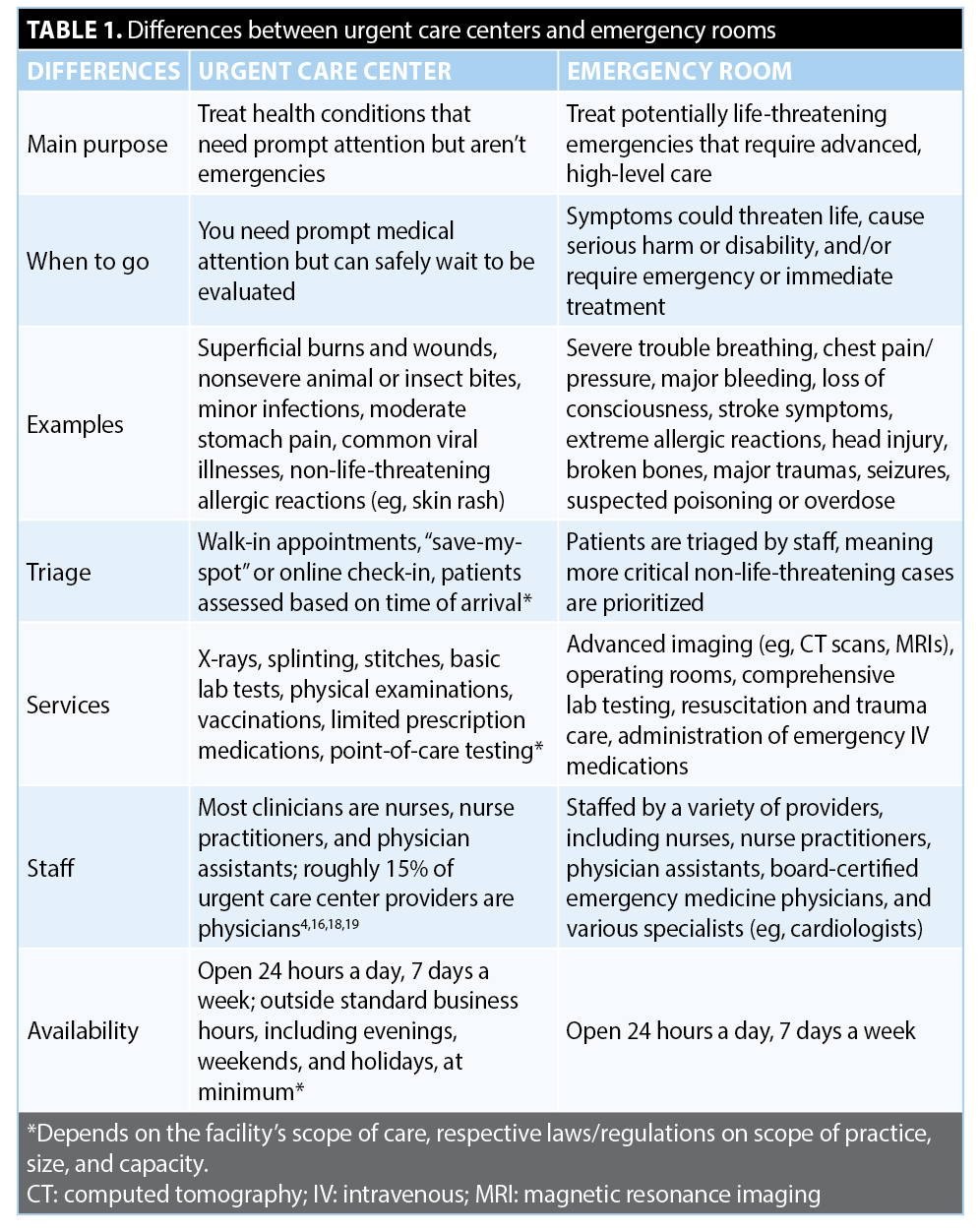
When deciding between a UCC visit or a trip to the ER, there is no perfect decision-making formula. Neither venue is inherently better than the other, and it’s worth noting that urgent care isn’t simply a cheaper version of the ER; it provides a different level of care for different medical needs. Multiple levels of care allow people to choose the most appropriate option for their situation, and understanding the differences between them can help you make a faster, more informed judgment call (Table 1).
Emergency Medicine Does Not Replace Primary Care
Urgent care has become a more popular and accessible treatment option. The number of UCCs has more than doubled in the last decade, with more than 15,000 of these clinics currently established in the United States (US).11,19 According to the US Centers for Disease Control and Prevention, 6% of people had at least 1 visit to a UCC in 2024.20,21 Many would argue that this is a net good. UCCs have been shown to improve healthcare accessibility for underserved populations, increase patient satisfaction, and alleviate the burden in emergency departments (EDs), leading to shorter wait times and improved resource allocation.22,23
Over the years, UCCs have started providing more routine services, such as employee or school physicals or disease testing. As these healthcare venues become more normalized and mainstream, some experts argue that the scope of UCCs’ practice has shifted beyond emergencies into cases that would be more appropriately managed by primary care providers (PCPs). Some clinicians have wound up treating patients with chronic conditions.8,12,20,21,24,25 There’s nothing wrong with the occasional use of UCCs for treating a sudden flare-up of certain health conditions, like asthma or high blood pressure, but consistently relying on these clinics for primary care matters is risky.
Because UCC visits are usually sporadic and patients are treated on a case-by-case basis, urgent care clinicians might not have access to your complete medical history. As a result, they may lack the full context needed to understand how your current symptoms fit into your overall health; they see only 1 piece of the puzzle. This can make it more difficult to identify underlying conditions or recognize patterns that develop over time.26–29 This can increase the risk of a missed or incorrect diagnosis or an inappropriate prescription. For example, a 2025 study published in the Annals of Internal Medicine found that UCCs inappropriately prescribe antibiotics, opioids, and steroid medications at high rates.11,30 At the same time, these clinics are often staffed by general practitioners and thus lack specialized care and expertise, which, in some cases, can have lethal consequences for the patient.11,22,31 These trade-offs may be reasonable for relatively healthy people. Ultimately, however, UCCs are not well equipped to manage longstanding symptoms or conditions.
A note on cost. Urgent care is generally a cheaper option than the ED, but there is nuance to this statement. A 2021 article in Health Affairs found that the average UCC visit cost $171, compared with $1,646 for an ED visit—a nearly 10-fold higher price tag.24,32 However, the researchers also found that the relative convenience of urgent care led to more visits to UCCs, which increased overall spending. In general, UCCs’ simpler administrative processes and lower costs than office-based or hospital-based care make urgent care a cheaper option. However, the price you pay ultimately depends on your insurance coverage and the services provided.
Tips, Tricks, and Advice for Urgent Care
If you decide urgent care is the right choice, a little preparation can make the experience easier. If possible, try to find a UCC affiliated with your healthcare system. This may allow the clinician to view your health history and streamline your medical records.11 You can also shop around. Ask your PCP for their recommendations or do your own research. Here are some questions to consider:
- What UCCs are nearby?
- What are their hours?
- Do they accept my insurance? What are the estimated cost(s)?
- What services do they provide (eg, x-rays, stitches, testing)?
Go to the urgent care armed with information about your condition. Bring your insurance card, a list of medications you take, and information about any relevant medical conditions or allergies. Be prepared to explain when your symptoms started, how they have changed, and what you have already done to treat them.4,11,12,17 Don’t forget to ask for a printed or digital copy of the visit’s summary notes before you leave. You can hand that off to your PCP, who can upload it to your patient portal and add it to your medical record.
Bottom line
UCCs and the ER are not in competition. Each serves its own purpose and is useful when you need medical attention quickly, but knowing where to seek care can make an already stressful illness or injury easier to navigate. When deciding between them, remember these 3 guidelines:
- If it’s potentially life-threatening, call 911/go to the ER.
- If it’s urgent but not an emergency, consider urgent care.
- If you’re unsure, call your PCP or a nurse advice line if available.
When possible, your PCP may be another option, particularly if they offer same-day appointments. With this in mind, taking a few minutes to research and review your options before an emergency strikes will help you make a more informed decision about your avenue of care.
Sources
- Farley KX, Aizpuru M, Boden SH, et al. Avocado-related knife injuries: describing an epidemic of hand injury. Am J Emerg Med. 2020;38(5):864–868.
- Dunn J. 6 things ER doctors wish you’d avoid. New York Times. 21 Feb 2025. Accessed 16 Sep 2026. https://www.nytimes.com/2025/02/21/well/er-doctors-tips.html
- Laskey M. How to cut an avocado without cutting yourself. New York Times. 1 May 2017. Accessed 16 Sep 2026. https://www.nytimes.com/2017/05/01/dining/avocado-injuries-cutting-safety.html
- Urgent care vs. the ER: how to choose where to go. Cleveland Clinic. 10 Sep 2026. Accessed 19 Sep 2026. https://health.clevelandclinic.org/urgent-care-vs-emergency-room
- Feeling sick? Learn where to go for care. Johns Hopkins Medicine. Accessed 23 Sep 2026. https://www.hopkinsmedicine.org/patient-care/patients-visitors/finding-right-care
- Abell R. ER, Urgent care or primary care: which should you choose? University of Colorado Medicine. 3 Mar 2025. Accessed 19 Sep 2026. https://www.cumedicine.us/health-insights/er–urgent-care-or-primary-care–which-should-you-choose
- Klasco R. How to (maybe) avoid sticker shock at the emergency room. New York Times. 7 Sep 2018. Accessed 19 Sep 2026. https://www.nytimes.com/2018/09/07/well/live/emergency-room-costs-medical-bills-urgent-care-virtual-care.html
- Where to go for medical care: ER vs. urgent care vs. virtual care. United Healthcare. Accessed 27 Sep 2026. https://www.uhc.com/member-resources/where-to-go-for-medical-care
- Vogel JA, Rising KL, Jones J, et al. Reasons patients choose the emergency department over primary care: a qualitative metasynthesis. J Gen Intern Med. 2019;34(11):2610–2619.
- Katella K. Should you go to the emergency department—or urgent care? Yale Medicine. 21 Oct 2025. Accessed 19 Sep 2026. https://www.yalemedicine.org/news/should-you-go-to-the-emergency-department-or-urgent-care
- Bajaj S. There’s a right and wrong way to use urgent care. New York Times. Updated 6 May 2026. Accessed 19 Sep 2026. https://www.nytimes.com/2026/05/03/well/urgent-care.html
- Urgent vs. emergency care: when to go and what’s the difference. Kaiser Permanente. Accessed 19 Sep 2026. https://healthy.kaiserpermanente.org/health-wellness/healtharticle.difference-between-urgent-and-emergency-care
- King G. Emergency vs. urgent care: differences. Mayo Clinic Health System. 3 Sep 2020. Accessed 27 Sep 2026. https://www.mayoclinichealthsystem.org/hometown-health/speaking-of-health/emergency-vs-urgent-care-whats-the-difference
- Emergency care and urgent care. FAIR Health. Accessed 20 Sep 2026. http://www.fairhealthconsumer.org/insurance-basics/healthcare/emergency-care-and-urgent-care
- Borke J. Recognizing medical emergencies. MedlinePlus. Updated 8 Jan 2025. Accessed 16 Sep 2026. https://medlineplus.gov/ency/article/001927.htm
- What is urgent care medicine? American Academy of Urgent Care Medicine. Accessed 16 Sep 2026. https://aaucm.org/what-is-urgent-care-medicine/
- Klein S. When to go to the emergency room vs. urgent care. TIME Magazine. 15 May 2025. Accessed 19 Sep 2026. https://time.com/7285524/when-to-go-emergency-room-vs-urgent-care/
- Fay B. Urgent care vs emergency room costs, differences and options. Debt.org. Updated 23 Jul 2024. Accessed 16 Sep 2026. https://www.debt.org/medical/emergency-room-urgent-care-costs/
- O’Malley P, Botchway A, Stoimenoff L, Fish L. Urgent care clinician procedural benchmarking survey results. J Urgent Care Med. 2025;20(1):5–7.
- Cohen RA, Briones EM. Urgent care center and retail health clinic use: United States, 2024. US Centers for Disease Control and Prevention. Updated 27 May 2026. Accessed 21 Sep 2026. https://www.cdc.gov/nchs/products/databriefs/db562.htm
- Cohen RA, Briones EM. Urgent care center and retail health clinic use: United States, 2024. NCHS Data Brief. 2026;(562):10.15620/cdc/252447.
- Allen L, Cummings JR, Hockenberry JM. The impact of urgent care centers on nonemergent emergency department visits. Health Serv Res. 2021;56(4):721–730.
- Alaqil NAN, Alanazi BG, Ali Alghamdi SA, et al. The role of urgent care clinics in alleviating emergency department congestion: a systematic review of patient outcomes and resource utilization. Cureus. 17(4):e81919.
- Wang B, Mehrotra A, Friedman AB. Urgent care centers deter some emergency department visits but, on net, increase spending. Health Aff (Millwood). 2021;40(4):587-595.
- Schmalstieg-Bahr K, Bessert B, Peters PS, et al. General practice-led urgent care practice vs. emergency room – satisfaction of ambulatory patients with low urgency medical problems. Eur J Gen Pract. 2025;31(1):2520218.
- Poyorena C, Patel S, Keim A, et al. Evaluating urgent care center referrals to the emergency department. J Am Coll Emerg Physicians Open. 2022;3(6):e12838.
- Ehlert D. Evidence-based patient triage: optimizing healthcare delivery through appropriate site-of-care selection. Cureus. 2026;18(1):e101602.
- Agarwal AK, Mahoney K, Lanza AL, et al. Online ratings of the patient experience: emergency departments versus urgent care centers. Ann Emerg Med. 2019;73(6):631–638.
- Kafer L, Hoffmann JA, Mathison D, et al. Nonemergency acute care delivered outside of the medical home: policy statement. Pediatrics. 2026;157(6):e2026077003.
- Cohen-Mekelburg S, Wallace BI, Kenney B, et al. Antibiotic, glucocorticoid, and opioid prescribing in urgent cares: an opportunity for reducing medication overuse. Ann Intern Med. 2025;178(10):1520–1523.
- Savira F, Frith M, Aditya CJ, et al. Urgent care centres for reducing the demand on emergency departments: a scoping review of published quantitative and qualitative studies. Med J Aust. 2025;222(9):450–461.
- Wang B, Mehrotra A, Friedman AB. Urgent care centers: lower-cost than emergency departments, but they increase spending. University of Pennsylvania Leonard Davis Institute of Health Economics. 26 Apr 2021. Accessed 27 Sep 2026. https://ldi.upenn.edu/our-work/research-updates/urgent-care-centers-lower-cost-than-emergency-departments-but-they-increase-spending/