
By Sarabeth Lowe, MPH
Ms. Lowe is a Communication Specialist at the University of Delaware Disaster Research Center.
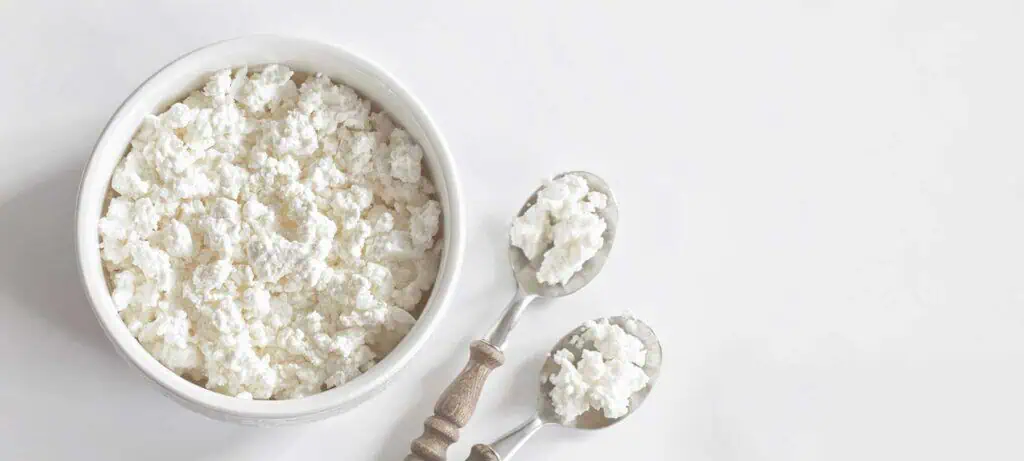
Ice cream. Pancakes. Tofu. Biscuits. Whether it’s scooped straight from the tub or spread across snack foods, cottage cheese is making a comeback.1–3 This dairy delicacy saw nearly 50 years of steady decline after peaking in popularity in the 1970s.1,4 In March 2025, however, Google searches for “cottage cheese” reached the highest levels since 2004.5 There are several reasons it has returned to the American diet—and TikTok—with such a vengeance. Here’s what you should know.
How it’s made
Similar to mozzarella and ricotta, cottage cheese is a curdled milk product. Making it is a relatively simple process, one that you can even carry out at home, that requires only a few ingredients and careful handling. It’s not an ultra-processed food. In fact, the term “cottage cheese” reflects its humble, pastoral origins; the cheese was generally made in cottage-type houses from leftover milk.1,6
Preparation begins by adding an acid, such as vinegar, to pasteurized milk. This separates the milk solids from the whey, forming a curd. This semisolid byproduct is removed at just the right moment and cut into small pieces, which are then cooked, washed, and pressed gently to absorb any remaining whey.1,4,5,7,8 These curds are rinsed, and other additives, such as cream and salt, are mixed in. All of these steps and ingredients give cottage cheese its tangy, mild flavor and unique, albeit lumpy, texture.
Nutrition profile
Though decades of research have shown that cottage cheese is a nutritious food, there is not a wealth of high-quality data from randomized controlled trials that definitively point toward specific health benefits.6 However, its excellent nutrient profile is well established, supporting its place in a healthy diet.2,7,9–13 It’s worth noting that cottage cheese is available in three types—nonfat, low-fat, or whole-fat—and that the type of milk and any added ingredients affect its nutritional content.12
Compared with other dairy products, cottage cheese is a relatively healthy option.13,14 A half-cup serving of full-fat cottage cheese contains around 100 calories, whereas an equal serving of ricotta cheese contains about 190 calories, and a three-quarter-cup serving of full-fat Greek yogurt has roughly 160 calories.2,14 A same-sized serving of 2% fat cottage cheese typically has less saturated fat and 5 times more potassium than hard cheeses.12,14 It is also an important source of selenium, riboflavin, magnesium, and phosphorus.1,2,7,11–15 Notably, cottage cheese is lower in calcium compared to other dairy products, and, unlike milk, is not generally fortified with vitamins A and D.1,11,15
At a glance: cottage cheese nutrition facts. The following information is provided by the United States Department of Agriculture for a 100-g (about 3.5 oz or just under a half cup) serving of low-fat (2% milkfat) cottage cheese.10,14
Calories: 84
Fat: 2.3 g
Sodium: 321mg
Carbohydrates: 4.3 g
Fiber: 0 g
Sugars: 4.1 g
Protein: 11 g
Calcium: 111 mg
Cottage cheese’s high protein content is perhaps one of its best selling points.1 In addition to providing a high amount of this essential macronutrient, cottage cheese is rich in casein.7,11,12,15–19 Casein is a complete protein, meaning that it contains all of the essential amino acids your body needs.12,20 It is also a slow-digesting protein, which can promote feelings of fullness and prevent spikes in blood sugar.21
Choices and Considerations
As with all foods, moderation is important. Cottage cheese tends to be high in sodium, which can increase blood pressure and, thus, your risk for heart attack and stroke.2,11,18–20,22 This is an especially important consideration because Americans, on average, already overconsume salt.17,22–24 The same applies to the fat content across different varieties. Though cottage cheese is relatively low in saturated fat, it still contributes to your overall intake. A diet rich in those kinds of food can raise your blood levels of low-density lipoprotein (“bad”) cholesterol, also increasing the likelihood of the same cardiovascular risks.2,13
Fortunately, grocery stores often carry multiple varieties of cottage cheese that range in their nutrient profiles and flavors. Here are some factors to consider when choosing the kind that best meets your needs and preferences.
Nutritional tradeoffs. Cottage cheese comes in three fat levels: fat-free (0%), low-fat (1%), reduced-fat (2%), and whole milk (4%). While low-fat options have fewer calories and more protein, some research shows that full-fat cottage cheese increases satiety.25 With moderation, any variety can fit into a healthy diet.
Sodium content. Because salt is a main ingredient in cottage cheese, even a small portion can significantly contribute to your overall sodium intake. Consider buying a low- or reduced-sodium option, ideally one that has 300 mg or less per serving.2,10,14,25–27
Probiotics. While many cottage cheeses are fermented, not all varieties contain probiotics, the live microorganisms that can improve gut health.25,27–30 If you are interested in this health benefit, look for labels that say “live” or “active cultures.”
Extra ingredients. For better or worse, some cottage cheeses contain extra ingredients. These can include ones that create a specific flavor profile, such as honey, herbs, and fruit, or additives that make the dish more appealing, such as artificial sweeteners, gums, and thickening agents. Many high-quality cottage cheese brands are made without these additional ingredients, and nutrition experts generally recommend prioritizing whole, unprocessed foods whenever possible.2,14,25–27
Lactose. During preparation, much of the whey is drained from cottage cheese, resulting in naturally lower lactose levels.10,31 Some people who are lactose intolerant can eat cottage cheese with few symptoms. If you are sensitive to lactose, look for containers labeled as “lactose-free.”
Texture. There is no nutritional difference between large-curd and small-curd cottage cheese; the difference in size is simply a result of how each type is made.11,14,26 However, large-curd cottage cheese tends to be higher in moisture, so it may be perceived as tasting creamier and sweeter than the latter. Small-curd varieties tend to taste slightly tangier and more acidic.14,26
There is no one-size-fits-all approach to choosing the type of cottage cheese that’s best for you, but experts suggest selecting a variety that is minimally processed with a fat content that suits your needs, at least 12 g of protein per serving, and no more than 300 mg of sodium per serving.
Bottom line
Cottage cheese is an affordable, nutritious, and wholesome food. Thanks to the surge of people on social media sharing alternative ways to use it, what some once called “boring” or “bland” is now being rediscovered as a versatile culinary staple. Whether you’re swirling it into a smoothie or sprinkling it alongside savory spices, this dairy darling is the perfect ingredient to encourage creativity in the kitchen and expand your palate.
Sources
- Bell L, Burch E. Cottage cheese is back and all over TikTok. Two dietitians explain why social media’s obsessed. The Conversation. 22 Aug 2024. Accessed 26 Jan 2026. https://theconversation.com/cottage-cheese-is-back-and-all-over-tiktok-two-dietitians-explain-why-social-medias-obsessed-236512
- Blum D. Cottage cheese makes a comeback. New York Times. 7 Jul 2023. Accessed 26 Jan 2026. https://www.nytimes.com/2023/07/07/well/eat/cottage-cheese-health-benefits.html
- Onque R. Health-conscious Millennials, Gen Zers are making cottage cheese cool again—but is it really that good for you? Updated 30 Jun 2023. Accessed 26 Jan 2026. https://www.cnbc.com/2023/06/30/health-conscious-millennials-gen-zers-make-cottage-cheese-cool-again.html
- Charles D. The fall of a dairy darling: how cottage cheese got eclipsed by yogurt. NPR. 16 Jul 2015. Accessed 26 Jan 2026. https://www.npr.org/sections/thesalt/2015/07/16/423207704/the-fall-of-a-dairy-darling-how-cottage-cheese-got-eclipsed-by-yogurt
- Google Trends – cottage cheese. Google Trends. Updated Dec 2025. Accessed 27 Jan 2026. https://trends.google.com/trends/explore? date=all&geo= US&q=cottage%20cheese&hl=en-US
- Reidy G, Hedrick T. Highlights of the cottage cheese industry in the USA II. Cultured Dairy Prod J. 1971;59(1):6–31.
- Farsi DN, Mathur H, Beresford T, Cotter PD. Cottage cheese, a relatively underexplored cultured dairy product with potential health benefits? Crit Rev Food Sci Nutr. 2025;65(32):7953–7963.
- Lucey JA. Cheese | Acid- and acid/heat coagulated cheese. In: Fuquay JW, ed. Encyclopedia of Dairy Sciences. 2nd ed. Academic Press; 2011:698–705.
- Cottage cheese. California Dairy Press Room & Resources. Accessed 26 Jan 2026. https://www.californiadairypressroom.com/Products/Cottage_Cheese
- Cheese, cottage, lowfat, 2% milkfat. US Department of Agriculture FoodData Central. 1 Apr 2019. Accessed 26 Jan 2026. https://fdc.nal.usda.gov/food-details/328841/nutrients
- Frey M. Cottage cheese: nutrition facts and health benefits. Verywell Fit. Updated 22 May 2024. Accessed 27 Jan 2026. https://www.verywellfit.com/cottage-cheese-nutrition-facts-calories-and-health-benefits-4109409
- 7 reasons why cottage cheese is good for you. Cleveland Clinic. 23 Aug 2023. Accessed 26 Jan 2026. https://health.clevelandclinic.org/cottage-cheese-benefits
- Moll J. Which cheeses are low in fat and cholesterol? Verywell Health. Updated 12 Dec 2025. Accessed 26 Jan 2026. https://www.verywellhealth.com/which-cheeses-can-i-eat-on-a-cholesterol-lowering-diet-697777
- What to look for in cottage cheese. EatRight.org – Academy of Nutrition and Dietetics. 11 Jul 2023. Reviewed 2 Jun 2025. Accessed 27 Jan 2026. https://www.eatright.org/food/food-groups/dairy-and-alternatives/what-to-look-for-in-cottage-cheese
- Dietary Guidelines for Americans 2025-2030: progress on added sugar, protein hype, saturated fat contradictions. Harvard TH Chan School of Public Health. 9 Jan 2026. Accessed 27 Jan 2026. https://nutritionsource.hsph.harvard.edu/2026/01/09/dietary-guidelines-for-americans-2025-2030
- Dietary Guidelines for Americans, 2025–2030. US Department of Agriculture. Jan 2026. Accessed 27 Jan 2026. https://cdn.realfood.gov/DGA.pdf
- 5 cottage cheese benefits — and how to add more to your diet. UCLA Health. 5 Dec 2024. Accessed 26 Jan 2026. https://www.uclahealth.org/news/article/5-cottage-cheese-benefits-and-how-add-more-your-diet
- Is cottage cheese healthy? Harvard TH Chan School of Public Health. 7 Jul 2023. Accessed 26 Jan 2026. https://hsph.harvard.edu/news/is-cottage-cheese-healthy/
- Venn BJ. Macronutrients and human health for the 21st Century. Nutrients. 2020;12(8):2363.
- What are complete proteins? Cleveland Clinic. 6 Dec 2022. Accessed 26 Jan 2026. https://health.clevelandclinic.org/do-i-need-to-worry-about-eating-complete-proteins
- Kohanmoo A, Faghih S, Akhlaghi M. Effect of short- and long-term protein consumption on appetite and appetite-regulating gastrointestinal Hormones, a systematic review and meta-analysis of randomized controlled trials. Physiol Behav. 2020;226:113123.
- Cordero DA Jr. Addressing the dangers of high sodium intake for better health. Int J Cardiol Cardiovasc Risk Prev. 2025;25:200403.
- About sodium and health. US Centers for Disease Control and Prevention. Updated 3 Feb 2025. Accessed 26 Jan 2026. https://www.cdc.gov/salt/about/index.html
- Berg S. What doctors wish patients knew about sodium consumption. American Medical Association. 15 Aug 2025. Accessed 26 Jan 2026. https://www.ama-assn.org/public-health/prevention-wellness/what-doctors-wish-patients-knew-about-sodium-consumption
- Kunik K. We asked dietitians how to choose the best cottage cheese—this is what they said. EatingWell. 13 Nov 2025. Accessed 27 Jan 2026. https://www.eatingwell.com/how-to-choose-the-best-cottage-cheese-11847051
- Giorgi A. What happens to your body when you eat cottage cheese every day. Verywell Health. Updated 15 Dec 2025. Accessed 27 Jan 2026. https://www.verywellhealth.com/cottage-cheese-11759307
- Coates H. Is cottage cheese healthy? Experts weigh in. Vogue. 10 Apr 2025. Accessed 27 Jan 2026. https://www.vogue.com/article/cottage-cheese-health-food
- Hemarajata P, Versalovic J. Effects of probiotics on gut microbiota: mechanisms of intestinal immunomodulation and neuromodulation. Therap Adv Gastroenterol. 2013;6(1):39–51.
- Probiotics: fact sheet for consumers. National Institutes of Health Office of Dietary Supplements. Updated 17 Nov 2025. Accessed 27 Jan 2026. https://ods.od.nih.gov/factsheets/Probiotics-Consumer/
- Li A, Zheng J, Han X, et al. Advances in low-lactose/lactose-free dairy products and their production. Foods. 2023;12(13):2553.